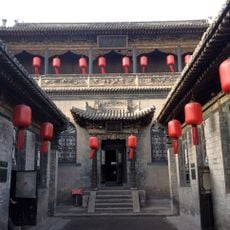
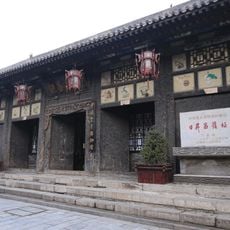
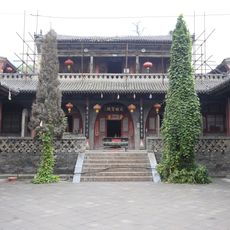
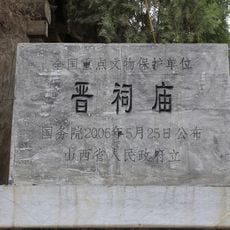
Jiexiu Houtu Temple, Daoist temple in Jiexiu, China.
Jiexiu Houtu Temple is a Taoist Quanzhen complex of 9,196 square metres in the old town's northwest corner, facing south along two parallel axes. The west axis runs from a Ming glazed screen wall through the mountain gate, a hall of guardians, the offering hall, the 15.2-metre Three Pure Ones Tower of 1309 and its theatre stage to the main Houtu hall; the east axis holds the Hall of the Child-Giving Goddess. Nearly every roof is covered in coloured glazed tiles.
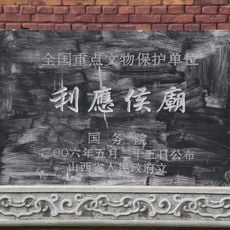
The founding date of Jiexiu Houtu Temple is unknown. In 1516, during the Ming Zhengde era, it was rebuilt and expanded to include the Zhenwu Hall on the east and the Sanguan Shrine on the west. In 1730, under the Qing Yongzheng emperor, a Tudi Temple was added, forming the present layout. The Sanqing Tower dates to 1309, the Yuan Zhida era; other buildings are Ming and Qing. It became a National Key Cultural Relic in 2001.
The temple belongs to the Quanzhen school of Daoism. Its theatre stage, about 13 metres high, is the tallest surviving Ming-dynasty stage; the space beneath it is only tall enough for one person to stand. On either side stand the earliest surviving Ming double-eaved splayed screens, their gable boards painted in purple and white glaze with a scene of mice stealing grapes.
The complex faces south and is entered from Miaodi Street in the northwest corner of Jiexiu's old town. Inside, two parallel north–south axes structure the visit: the west axis runs from the Three Pure Ones screen wall through the gate hall, Dharma-protector hall, offering hall and Three Pure Ones Tower to the Houtu Hall, while the east axis leads from its own screen wall through a gate and passage hall to the Zisun Niangniang Hall. Look up at the glazed roofs as you go.
The stage tower rises 13 metres, the tallest surviving Ming-dynasty theatre stage; its lower level is only high enough for one person to stand upright. Flanking it, the double-eaved splayed screen walls are the earliest Ming examples of their kind, their gable boards painted with a purple-and-white glaze scene of mice stealing grapes.
The community of curious travelers
AroundUs brings together thousands of curated places, local tips, and hidden gems, enriched daily by 94,341 contributors worldwide.