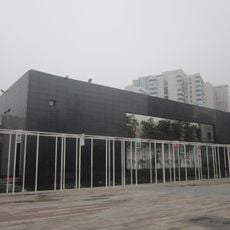
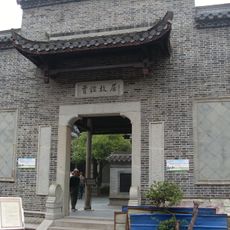
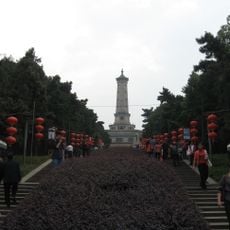
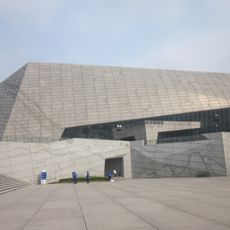
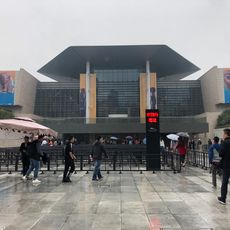
Hunan Museum, Regional museum in Kaifu District, Changsha, China.
Hunan Museum stands at No. 50 Dongfeng Lu in Changsha's Kaifu district, beside the Revolutionary Martyrs' Park. The present building, designed by the China Central Academy of Fine Arts with Japanese architect Arata Isozaki, opened in 2017 and covers about 49,000 square metres, with 91,000 square metres of floor area. Its galleries hold more than 180,000 objects, among them the Mawangdui tomb finds.
The museum opened in 1956 and holds objects spanning from the Neolithic Period through the Han Dynasty. Its collection includes 763 first-class relics recognized as nationally important, providing evidence of cultural development across millennia.
The museum's name changed from Hunan Provincial Museum to Hunan Museum in July 2022, then back to Hunan Provincial Museum in October 2025. Its permanent galleries are organised by material and period: Mawangdui Han tomb finds, Shang and Zhou bronzes from Hunan, ceramics from the Xiangyin, Changsha and Liling kilns, and Ming-Qing calligraphy and painting shown in rotation. The Four-goat Square Zun, a Shang bronze, was unearthed in Hunan.
The museum stands at No. 50 Dongfeng Road in Kaifu District, beside the Revolutionary Martyrs' Park. It is open Tuesday to Sunday from 9:00 to 17:00, with last entry at 16:00, and closed on Mondays except national holidays and on Lunar New Year's Eve. Admission to the permanent exhibitions is free since 20 March 2008; bring a second-generation ID card or collect a same-day ticket with other documents.
The plain gauze robe from Mawangdui Tomb No. 1 weighs only 49 grams; folded, it fits inside a matchbox. Excavated in 1972, it is among the 11 Hunan Museum objects banned from leaving China for exhibition.
The community of curious travelers
AroundUs brings together thousands of curated places, local tips, and hidden gems, enriched daily by 94,022 contributors worldwide.