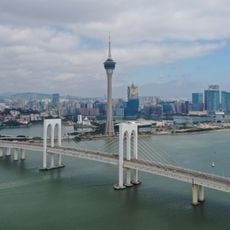
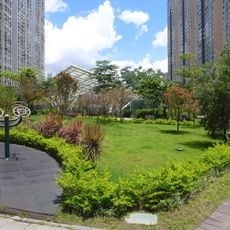
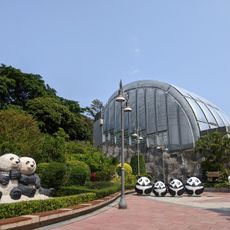
Museum of Taipa and Coloane History, Historical museum in Taipa Village, China.
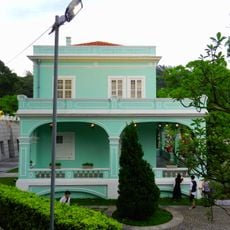
The Museum of Taipa and Coloane History occupies a two-storey green neoclassical building with a Roman-style triangular pediment and a ground-floor arcade of continuous arches. Its nine galleries cover 638 square metres: the ground floor holds excavated relics and a basement stone-structure site, while the upper floor recreates the former Island Municipal Council meeting room and displays agricultural tools, a shrimp-paste mill, firecracker-making and boatbuilding models.
The building was constructed in 1920 as the Island Municipal Council Building, replacing an earlier structure on the site. It served as the administrative centre for the islands of Taipa and Coloane during Portuguese rule and was listed as a building of architectural value in 1992. Renovated from 2002, it reopened as the Museum of Taipa and Coloane History on 7 May 2006.
The galleries show how people lived and worked on the islands across different eras, featuring everyday objects, religious items, and traditional crafts that reveal local customs. Visitors see how these communities developed and what shaped their way of life over time.
The museum is open from Tuesday through Sunday and offers a straightforward path through two exhibition floors that work well for most visitors with different interests. The green building is easy to locate and the layout is clear and simple to navigate.
The stone foundations and drainage channel found beneath the building were excavated between 2004 and 2005, not earlier. This was the first archaeological dig in Macau led entirely by local archaeologists and the first since the 1999 handover. The exposed remains are now part of the ground-floor display.
The community of curious travelers
AroundUs brings together thousands of curated places, local tips, and hidden gems, enriched daily by 93,803 contributors worldwide.