Hua Bridge
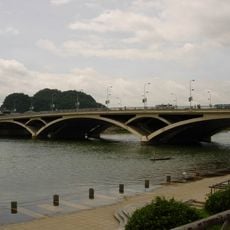
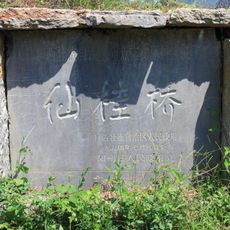
Hua Bridge spans the Xiao Dong River in Qixing Park with a total length of 134.66 metres. Its eleven arches are divided into four water arches on the east and seven dry arches on the west, decreasing in size from east to west. A pavilion stands over the water arches, and the pavilion and dry-bridge railings are built of concrete.
A five-arch stone bridge with a pavilion already appears on the Song-dynasty Jingjiang Prefecture City Wall Map, built under the Jiaxi era and called Jiaxi Bridge. Floods destroyed it around the Yuan-Ming transition; in 1456 prefect He Yongquan laid planks on the old foundations. In 1540 a donation from Consort Xu of Prince Ansu of Jingjiang expanded it to eleven arches, four water and seven dry, and it took the name Hua Bridge in the Ming.
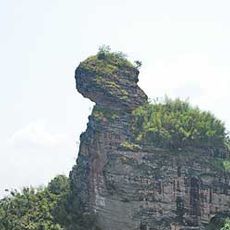
The bridge's name changed with its surroundings: it was called Jiaxi after the Song-era reign in which it was built, then Hua ("flower") in the Ming because of the dense flowers and trees on both banks. In the Qing it was renamed Tianzhu, "Heavenly Pillar", for the small hill rising at its east end. That rock, also called Furong Stone, still carries the inscription "Long live Mao Zedong Thought" carved on it during the Cultural Revolution.
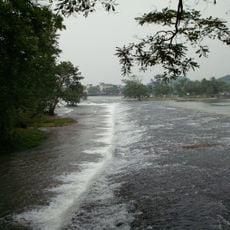
The bridge crosses the Xiao Dong River inside Seven Star Park, near where the Lingjian Creek joins it. Its eleven arches shrink from east to west: four water arches on the east side and seven dry arches on the west. In normal conditions the river runs through the water arches; during floods the dry arches help drain the flow.
The small stone pillar at the bridge's east end, called Furong Stone, was renamed Tianzhu Bridge in the Qing dynasty; during the Cultural Revolution the characters "Long Live Mao Zedong Thought" were carved into it and remain visible today.
The community of curious travelers
AroundUs brings together thousands of curated places, local tips, and hidden gems, enriched daily by 93,086 contributors worldwide.