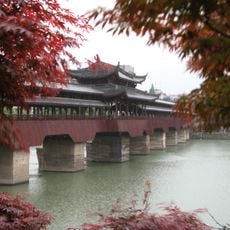
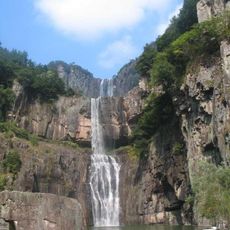
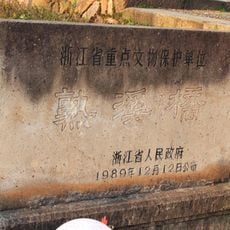
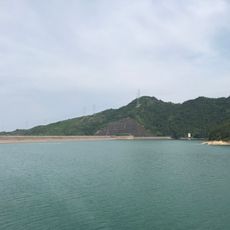
Tongji Weir, Historical water management site in Lishui, China.
Tongji Weir is a historic water management site in Lishui that uses a system of gates and channels to direct water flow for agricultural irrigation. The structure demonstrates how water has been distributed across different field areas through engineering designed centuries ago.
The weir system was built in ancient times to secure water supply for fields in the region, demonstrating the technical knowledge of early Chinese engineers. It has retained its basic structure through centuries and continues to function today as a working irrigation system.
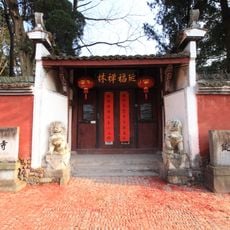
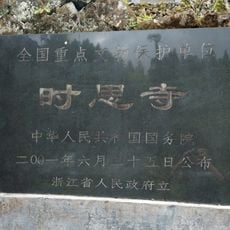
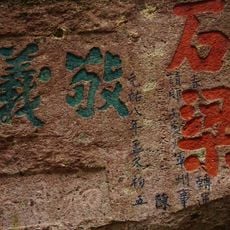
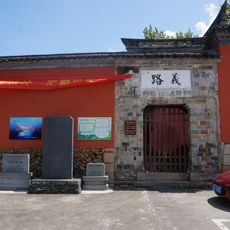
The sources do not explain the name Tongji; what a visitor can see today is the working system: the arch dam feeds the Tongji sluice, and water flows through a 22.5 km main canal, 48 branch canals and 321 field channels to irrigate the Bihu plain. Beside the sluice stands the Sima Temple, which keeps eighteen inscriptions from successive dynasties.
Tongji Weir lies at Yantou village in Bihu town, Liandu district, Lishui, Zhejiang. The 275-metre arch dam, the Tongji sluice beside its north end and the Sima temple with eighteen stone inscriptions stand close together, while the 22.5 km main canal runs downstream through the Bihu plain. Visitors walk the dam crest and canal banks; the sources give no opening hours or fees.
The weir system still functions today much as it did in ancient times, actively irrigating fields in the region. This makes it a rare example of ancient engineering that remains not just preserved but actually alive in daily use.
The community of curious travelers
AroundUs brings together thousands of curated places, local tips, and hidden gems, enriched daily by 93,087 contributors worldwide.