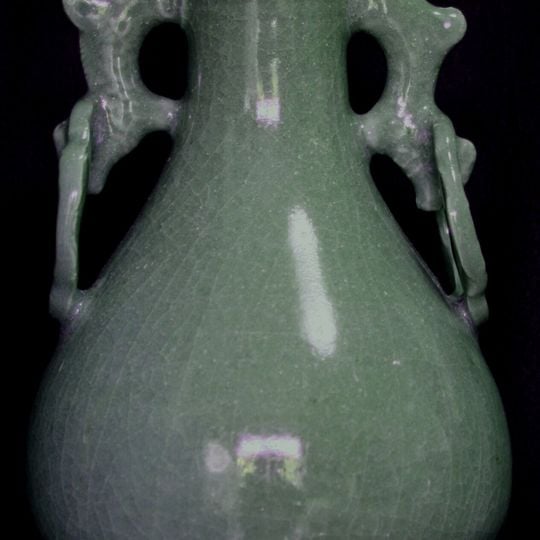
Longquan celadon, Traditional ceramic production center in Lishui Prefecture, Zhejiang Province, China.
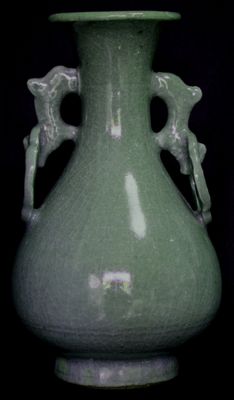
Longquan celadon is a traditional ceramic produced in the Lishui region of Zhejiang Province featuring a distinctive greenish-blue glaze that gives vessels a jade-like appearance. The thick-walled pieces are covered with a smooth, lustrous surface that shows remarkable depth of color.
Kilns at Longquan in southwestern Zhejiang began large-scale production under the Northern Song, around the 10th century. Output and quality rose sharply after the capital moved to Hangzhou in 1127, and the wares dominated Chinese ceramic exports for over five hundred years. Dragon kilns with up to twelve chambers fired as many as 25,000 pieces at a time. Production declined after Jingdezhen blue-and-white overtook these markets in the Ming.
The Chinese name 龙泉青瓷 links the wares to Longquan, the kiln centre in Zhejiang, and to celadon's green glaze. In the Southern Song, potters developed the thick lime-alkali glazes fenqing (powder blue) and meiziqing (plum green), compared to jade. The traditional firing technique was inscribed on UNESCO's Representative List of the Intangible Cultural Heritage of Humanity in 2009.
The kilns were long dragon kilns, brick tunnels rising up a slope with up to twelve chambers, able to fire as many as 25,000 pieces at a time. The best results came from pots in the uppermost stages, which heated more slowly and evenly. Saggars were always used, and firing temperatures ranged between 1,180 °C and 1,280 °C, with over 1,250 °C giving the best green or blue colours.
The unglazed foot ring of a Longquan piece fires to a reddish brown, a feature known as "purple rim and iron foot" (紫口铁足) that distinguishes it from northern celadons. This effect comes from iron in the clay oxidizing when fresh air enters the kiln at the end of firing.
The community of curious travelers
AroundUs brings together thousands of curated places, local tips, and hidden gems, enriched daily by 93,256 contributors worldwide.