Temple of Wu Wenjian, Ancestral hall in Yueshan village, Qingyuan County, China
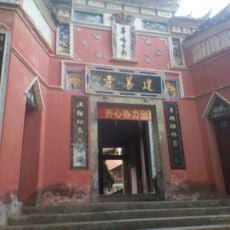
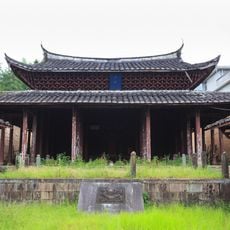
The Temple of Wu Wenjian (吴文简祠) is an ancestral hall in Yueshan village, Jushui township, Qingyuan county, Zhejiang. First built in 1522, the first year of the Ming Jiajing era, it covers 688.04 square metres and runs through three successive halls: a gate tower, a main hall and a rear hall. Its carpentry includes ruyi-shaped brackets and a reduced-column construction, and the column bases are carved.
Wu Wenjian Ci was first built in 1521, the first year of the Ming Jiajing reign, in Yueshan village, Jushui township, Qingyuan County. It is a ancestral hall of the Wu lineage, not a temple, and its three halls were raised over subsequent centuries. In 2019 it was listed in the eighth batch of Major Historical and Cultural Sites Protected at the National Level.
The hall is a lineage ancestral hall for the Wu family of Yueshan village, not a temple of Wenchang or Lord Guan. Its name honours Wu Wenjian, the posthumous title of a Wu ancestor, and the building served the clan's rites and gatherings. Look for the carved column bases and the 如意拱 brackets in the main hall.
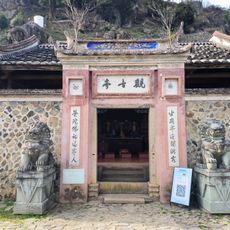
The hall stands in Yueshan village, Jushui township, Qingyuan County, and is a protected national heritage site, so visits are best arranged around village life rather than as a formal attraction. The three-bay layout runs from the gate tower through the main hall to the rear hall, giving a clear route through the building.
The hall is named for Wu Wenjian, a local figure remembered by the Wu clan of Yueshan village, and it served as the clan's ancestral hall rather than a temple. Its 2019 listing as a Major Historical and Cultural Site Protected at the National Level made it one of the eighth batch of such sites.
The community of curious travelers
AroundUs brings together thousands of curated places, local tips, and hidden gems, enriched daily by 93,375 contributors worldwide.