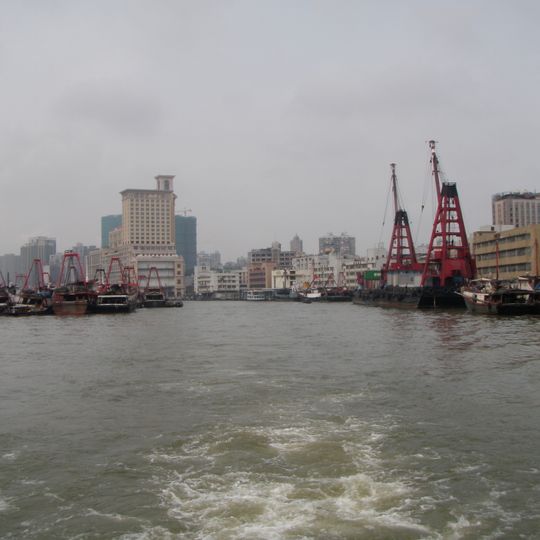
Port of Macau, Maritime port in Macau SAR, China.
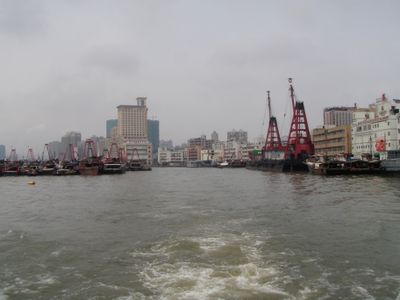
The Port of Macau comprises four areas: the Interior Port (Porto Interior), a 3,500-metre stretch of 34 wharves from Lighthouse No. 12 to the tip of Patane, used for cargo, river transport and fishing; the Exterior Port with the old Fishing Wharf and Macau Ferry Terminal; the Taipa Ferry Terminal; and Kai Ho Port on Coloane, with the container and oil terminals.
Portuguese traders began using Macau as a trading post in the 16th century, turning it into one of the first European footholds on the Chinese coast. Over the centuries, the port grew from a small fishing bay into a key link between Europe and East Asia.
The name Porto Interior (Inner Harbour) covers 34 wharves along a 3,500-metre stretch from Lighthouse No. 12 to the tip of Patane. Wharf 23, built in 1948 and run from the 1960s by Iau Tak Shipping as Iau Tak Wharf, handled scheduled cargo to Hong Kong; Wharf 25, built in 1950 as Yu Wo Wharf, ran passenger and cargo services to Jiangmen.
The Inner Harbour runs 3,500 m along the west side of the Macau peninsula, from Lighthouse No. 12 to the tip of Patane, with a fairway 45–55 m wide and 3.5 m deep. It is a working cargo, river-transport and fishing dock area of 34 piers, not a cruise port; passenger ferries use the Inner Harbour Ferry Terminal and the Outer Harbour terminal. Piers 23 and 25, built in 1948 and 1950, are being restored for cultural and retail use.
The Interior Port stretches 3,500 metres from Lighthouse No. 12 to the tip of Patane, with 34 wharves in all. In 1985, 38 wharves stood here with 12 warehouses. Wharf 23, built in 1948, became Yau Tak Wharf under Yau Tak Shipping in the 1960s, running scheduled cargo services to Hong Kong.
The community of curious travelers
AroundUs brings together thousands of curated places, local tips, and hidden gems, enriched daily by 95,039 contributors worldwide.