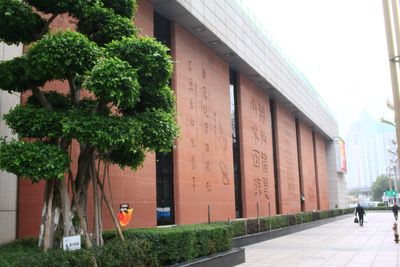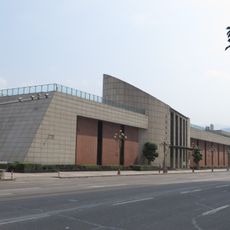
Baiheliang Underwater Museum, Underwater archaeological museum in Fuling District, Chongqing, China
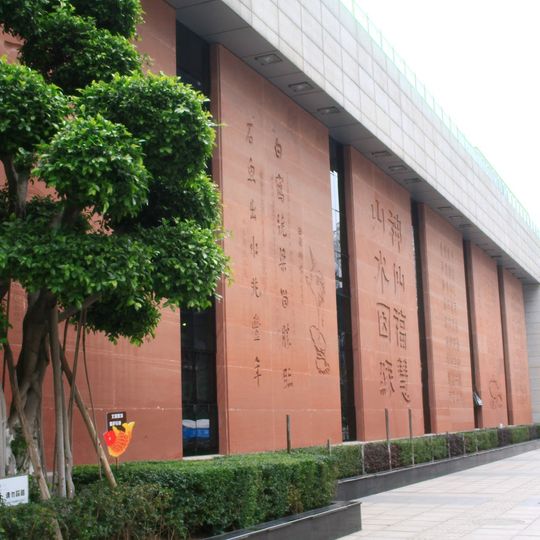
The Baiheliang Underwater Museum encloses the 1,600-metre-long White Crane Ridge in an arch-shaped glass cover filled with purified water, keeping pressure equal on both sides. Two underwater channels with long escalators descend from the riverbank to a 60-metre ring corridor, where 23 round windows show the submerged carvings.
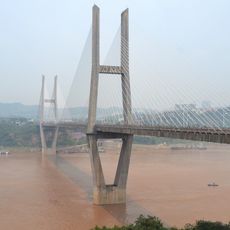
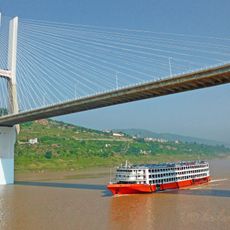
Before a major hydroelectric project flooded the area, this site lay exposed on a river ridge. The submersion prompted the creation of the museum to preserve the ancient markers that would otherwise have been lost.
The stone inscriptions here document how people monitored and understood the river's behavior across many centuries. They reveal a long tradition of marking important natural cycles and observations for future generations.
Visitors descend from the riverbank by a 91-metre escalator into a sloped corridor, then continue along a 150-metre horizontal corridor to a steel hatch about 1 metre wide and 0.5 metres thick. Beyond it, a 60-metre ring corridor with 23 round observation windows looks onto the submerged ridge, roughly 40 metres below the Yangtze surface.
The protective vessel was proposed by Ge Xiurun of the Institute of Rock and Soil Mechanics, Chinese Academy of Sciences, and chosen over a scheme meant to seal the carvings off from the river entirely. Its filtered water is held at the same pressure as the Yangtze outside, keeping the arch stable. Visitors reach the carvings by a 91-metre escalator.
The community of curious travelers
AroundUs brings together thousands of curated places, local tips, and hidden gems, enriched daily by 93,080 contributors worldwide.