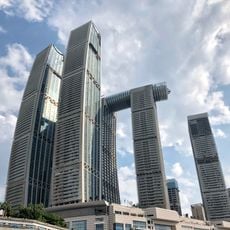
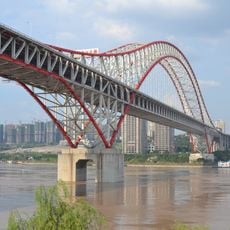
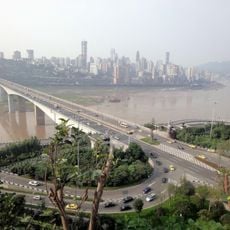
Dongshuimen Yangtze River Bridge, Combined truss and cable-stayed bridge in Chongqing, China
The Dongshuimen Yangtze River Bridge is a combined truss and cable-stayed bridge spanning 1,125 meters across the Yangtze, connecting Yuzhong and Nan'an districts with a dual-deck structure. The upper deck carries four vehicle lanes while the lower deck accommodates two rail transit lines.
The main tower foundations broke ground on 29 December 2009, and the towers were topped out on 1 December 2012. The main span was joined on 6 February 2013, and the upper road deck opened to traffic on 31 March 2014. The design was first drawn up for rail transit alone, then changed to a combined road-rail bridge to avoid wasting resources.
The two main towers are shaped as rounded "tian suo" forms, a reference to the shuttles of traditional weaving, and the south tower reaches 172.61 metres while the north tower reaches 162.49 metres. The bridge is known together with the Qiansimen Jialing River Bridge as the "Two Rivers Bridges".
The upper deck carries four urban secondary-road lanes with a design speed of 40 km/h; the lower deck holds the two tracks of Chongqing Rail Transit Line 6. The bridge has no separate pedestrian or cycle paths, so crossing on foot is not possible. The main span measures 445 metres between the two towers.
The bridge was the first in the world to use a cable-girder anchorage system, and its cable-tower anchorage tonnage ranks first worldwide. Each stay cable consists of 139 parallel steel strands and can bear a maximum tensile force of 1,450 tonnes, a world record for bridges. The large bearings under the main towers are supported by bracket (corbel) structures, also a first.
The community of curious travelers
AroundUs brings together thousands of curated places, local tips, and hidden gems, enriched daily by 93,086 contributors worldwide.