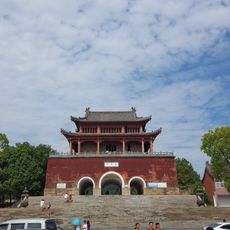
Yichang Tianran Pagoda, Ancient pagoda in Yichang, China.
Yichang Tianran Pagoda is a multistory structure in Yichang, China, featuring detailed stone carvings and traditional architectural elements throughout its form. The tower displays classic Chinese craftsmanship through its tiered construction and symmetrical design at every level.
According to records, the pagoda was first built in the Jin dynasty by the writer Guo Pu, who lived in Yiling at the end of the Western Jin; it was repaired over the centuries and fell into disuse under the Ming. The present brick pagoda was rebuilt in 1790–1792 (Qianlong 55–57) with funds from more than ten Donghu County gentry, including Xu Jingye and Wang Yongyan. It was listed as a Yichang municipal protected site in 1962, a Hubei provincial one in 1992, and a national one in 2019.
The name Tianran, "natural", is explained by the pagoda's setting on the Yangtze bank at the foot of the tower hill; the five Qing donors who paid for the 1790–1792 rebuilding were gentry of Donghu County, among them Xu Jingye and Wang Yongyan. The west-facing ground-floor door opens toward the river, and its couplet compares the tower to a jade pillar guarding the Jingmen passes.
The location is easily reachable by local transportation services in Yichang and sits in a well-connected area. Visitors should wear sturdy shoes and prepare for stairs and uneven surfaces, as the structure has multiple levels to explore.
In 2001, when the riverside avenue was extended, planners rerouted a 700-metre stretch from a straight line into a curve to avoid the pagoda, at an added cost of 10 million yuan. The tower's base is ringed by eight stone figures of Vajra guardians carved as if bearing its weight.
The community of curious travelers
AroundUs brings together thousands of curated places, local tips, and hidden gems, enriched daily by 93,202 contributors worldwide.