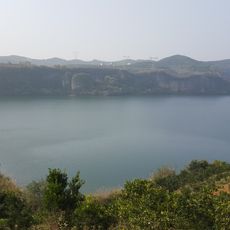
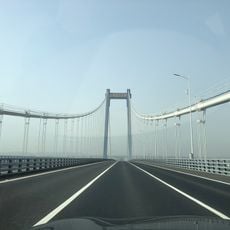
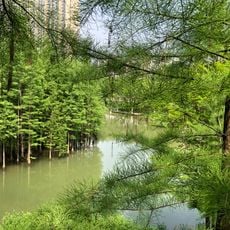
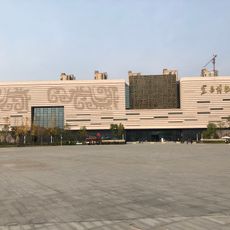
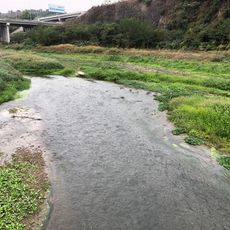
Hongze Lake Levee, Flood control levee at Hongze Lake in Huai'an, China.
The Hongze Lake Levee, historically called Gaojiayan, runs along the eastern shore of Hongze Lake in Huai'an, Jiangsu. Its facing side is clad in a 60.1 km vertical stone wall, 7 to 8 m high, laid out in 108 bends between 1580 and 1751. The wall is built of over 60,000 uniform blocks, each 0.8 to 1.2 m long and 0.4 m wide and thick.
The levee was first built in 200 AD under the Eastern Han dynasty, when Chen Deng, governor of Guangling, raised a 30-li embankment among the lakes northeast of the Huai River. Under the Ming, Chen Xuan worked on the stretch between Wudun and Zhouqiao, and Pan Jixun extended it to Jiangba. Qing river administrators such as Jin Fu and Zhang Penghe continued rebuilding it into its present form.
Locals call the levee Gaojiayan, after the Gao family embankment of the early section. Along its line stand the sites of the Ren, Yi, Li, Zhi and Xin flood-discharge dams, of which the Xin dam is the best preserved, together with the Zhouqiao overflow dike, an iron ox for calming the waters, a Qianlong imperial stele and the Sanhe sluice.
The stone facing runs along the lakeside of the levee, so walk or cycle the crest to see the 108 bends and the surviving flood-diversion dams, including the well-kept Xin Dam. The Sanhe Sluice, the Zhenshui iron ox and the Qianlong stele stand along the route; allow time to stop at each.
The levee is known as the "Great Wall on the Water" for its 108 bends and its facing of more than 60,000 uniform stone blocks, each 0.8 to 1.2 m long and 0.4 m wide and thick, laid between 1580 and 1751. Among the flood-diversion dams along the line, the Xin dam is the best preserved.
The community of curious travelers
AroundUs brings together thousands of curated places, local tips, and hidden gems, enriched daily by 92,807 contributors worldwide.