St. Cecilia's Church, Romanesque church museum in Altstadt-Süd, Germany.
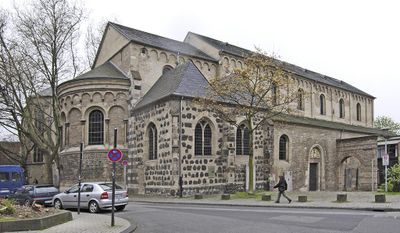
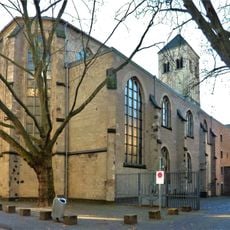
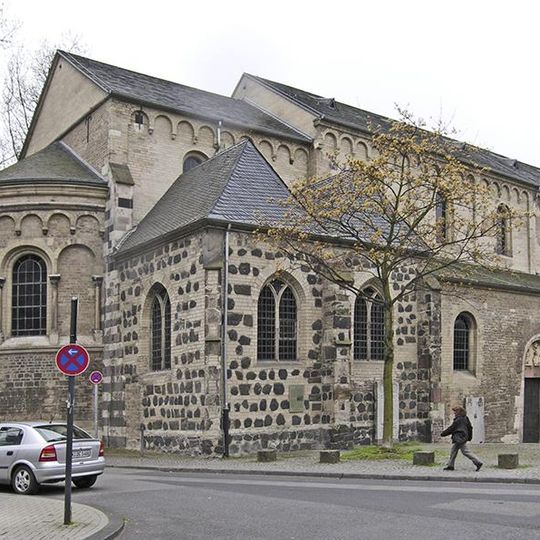
St. Cecilia's is a towerless, three-aisled Romanesque pillar basilica without a transept, built of rough dark stone with lighter window surrounds. The south aisle and nave end in rounded apses, while the north aisle ends in a sacristy added in 1479. The nave has a flat wooden ceiling, the aisles cross-groin vaults, and a 1160 tympanum copy stands over the north portal.
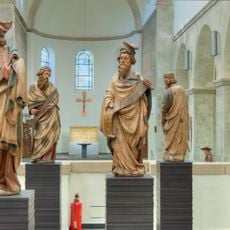
A women's religious community founded here in the late 9th century, under Archbishop Willibert (870–888), on the ruins of a Roman bath; Archbishop Bruno bequeathed 50 pounds of silver in 965 to complete its church. The Ottonian building was replaced by the present Romanesque structure in 1130–60, and in 1474 Augustinian nuns from Maria zum Weiher took over, adding the sacristy in 1479. Secularized in 1802, the church has housed the Schnütgen Museum since 1956.
The church is named after Saint Cecilia of Rome, to whom the 9th-century women's foundation was dedicated. Two masses are still held each year: at Christmas and on Saint Cecilia's feast day. The tympanum made in her honour around 1160 is now in the museum, with a copy above the north portal.
The museum is easily reached by public transport and sits centrally in the old town. Keep in mind that stairs to the upper choir are steep and interior spaces are compact, so crowded periods may feel confined.
The church stands on the site of a Roman bath, and excavations also uncovered the foundations of a rectangular predecessor church rather than the first Cologne Cathedral, as was long assumed. The 1160 tympanum honouring St Cecilia is a copy over the north portal; the original is kept in the museum.
The community of curious travelers
AroundUs brings together thousands of curated places, local tips, and hidden gems, enriched daily by 93,847 contributors worldwide.