Königssee, Natural lake in Schönau am Königssee, Bavaria, Germany
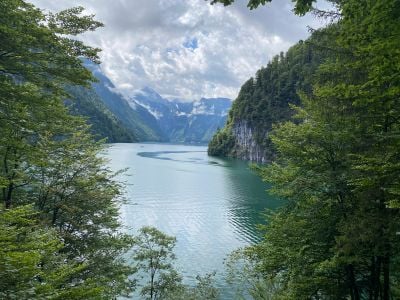
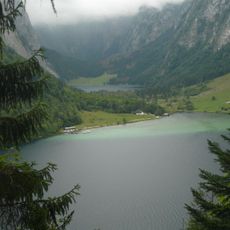
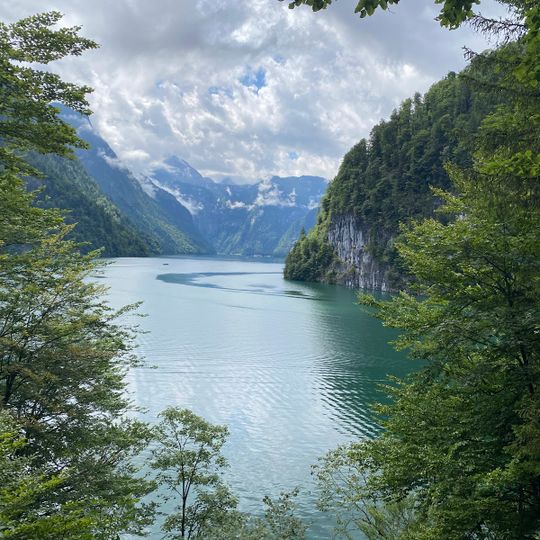
Königssee is a natural lake in Berchtesgaden National Park in Germany, stretching 7.7 kilometers (4.8 miles) through the Berchtesgaden Alps and reaching depths of 190 meters (623 feet). Its shores are formed by vertical limestone cliffs that rise directly from the green water, giving it a fjord-like appearance.
The lake occupies a tectonic rift from the late Jurassic that the Königssee glacier scoured several hundred metres deep during the ice ages, leaving a basin up to 190 m deep. From the 12th century the name derives from Kuno von Horburg, co-founder of the Berchtesgaden monastery, not from a king; the spelling Königssee with two s has been standard since the late 19th century.
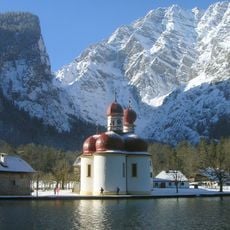
The name probably comes not from a king but from Kuno von Horburg, co-founder of the Berchtesgaden monastery, whose name became "Künigspach" and then Königsbach. Records from the 15th century call the lake Chunysee or Kunysee, and the double-s spelling has been standard since the late 19th century. The chapel Kuno founded was consecrated on 24 August 1134 and rebuilt in 1698 as the domed St. Bartholomä.
Electric passenger boats run daily from April to October, departing from Seelände with stops at Sankt Bartholomä and Salet. The ride to the first stop takes about 35 minutes and offers clear views of the rock walls on both sides.
Boat captains demonstrate the acoustic properties of the water by playing trumpet notes that bounce multiple times between the steep rock walls. This natural echo occurs because of the particular geometry of the limestone walls, which stand parallel to each other.
The community of curious travelers
AroundUs brings together thousands of curated places, local tips, and hidden gems, enriched daily by 92,527 contributors worldwide.