Kaiserbrücke, Railway bridge in Mainz, Germany.
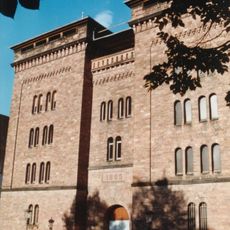
The Kaiserbrücke, today officially Nordbrücke, is a two-track railway bridge on the Mainz bypass line, crossing the Rhine at kilometre 500.9 between Mainz Nord and Wiesbaden Ost stations. Its five original steel arch spans, up to 116.8 m wide, were replaced after 1945 by box trusses; the massive abutments with two road underpasses each and the neo-Romanesque main tower on the Mainz side survive.
Emperor Wilhelm II opened the original bridge on May 1, 1904. It was destroyed in 1945 and later rebuilt, being renamed Nordbrücke in 1955.
The bridge's decorative programme was designed by Berlin architect Franz Schwechten in neo-Romanesque style, not Art Nouveau. Much of the relief sculpture by Gotthold Riegelmann (1864–1939) survives on the structure. Two large copper busts of Kaiser Wilhelm II and Grand Duke Ernst Ludwig, modelled by Walter Schott, once stood on the main tower's narrow sides and were probably removed soon after 1918.
Trains operated by Deutsche Bahn use this bridge regularly for connections between Mainz and Wiesbaden. You can observe the bridge from riverside paths or nearby streets.
The 1904 relief carvings by sculptor Gotthold Riegelmann survive on the bridge architecture, but the two copper busts of Kaiser Wilhelm II and Grand Duke Ernst Ludwig on the main tower's narrow sides are gone, possibly removed soon after 1918. The Italian dictator Benito Mussolini is said to have worked on the site as a migrant labourer in 1903–1904.
The community of curious travelers
AroundUs brings together thousands of curated places, local tips, and hidden gems, enriched daily by 93,853 contributors worldwide.