Russian Orthodox Chapel, Eastern Orthodox church building in Historical Cemetery, Weimar, Germany
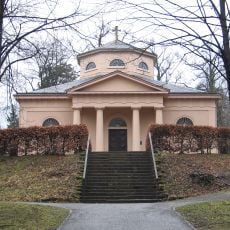
The Russian Orthodox Chapel of St Mary Magdalene stands on a high base on the Historical Cemetery, directly behind the Fürstengruft. Its five copper-covered cupolas are painted with patterns, and its outer walls are banded in yellow and brown ochre. The interior measures 11 by 9 metres and holds a white-and-gold carved iconostasis with eight icons.
Maria Pavlovna, a Russian grand duchess and regent of Saxe-Weimar-Eisenach, ordered a Russian Orthodox chapel built over her grave. Carl Heinrich Ferdinand Streichhan designed it, and it was erected from 1860 to 1862 under Grand Duke Carl Alexander. Soil from near Saint Petersburg was heaped into a mound on the cemetery, and the chapel was consecrated on 24 November 1862 by archpriest Stefan Sabinin.
The chapel reflects the presence of Russian Orthodox believers who lived in Weimar during that era. It served as a spiritual center for Russian visitors and residents seeking their own religious traditions.
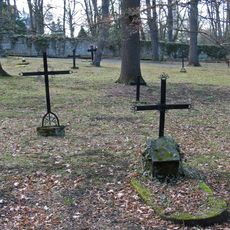
The chapel stands on the Historical Cemetery directly behind the Fürstengruft, reached on foot through the cemetery grounds. It is not open continuously; visits are possible on guided tours arranged by the city of Weimar, with times posted by the tourist office. The crypt and the spiral stair to the vault are closed off by a metal plate.
A spiral staircase once led from the chapel down into the passage to the Fürstengruft; it is now sealed with a metal plate. Maria Pawlowna's coffin stands in the passage itself, her husband Karl Friedrich's directly beside it.
The community of curious travelers
AroundUs brings together thousands of curated places, local tips, and hidden gems, enriched daily by 93,090 contributors worldwide.