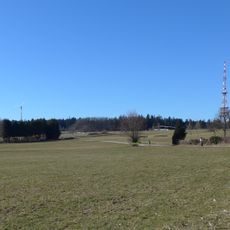
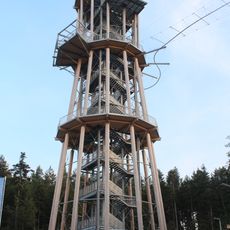
Nordschwarzwaldturm, Television tower in Schömberg, Germany.
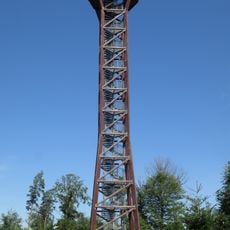
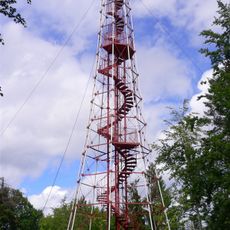
The Nordschwarzwaldturm is a steel lattice structure that rises 148 meters above the landscape and transmits television and radio signals across Baden-Württemberg. Its antenna array at the top broadcasts at power levels between 100 and 170 kilowatts, reaching throughout the forested region.
The steel lattice tower was built in 1964 and entered service on 5 September 1964, when ZDF began broadcasting from it. In 1966 the SDR joined as a tenant with a transmitter for the First Television Programme, and the Third Television Programme followed in 1969. Since 1974 the SDR, today the SWR, has also used the site for radio broadcasting; on 5 November 2008 DVB-T digital television followed, for which the glass-fibre-reinforced plastic cylinder at the top was replaced.
The site's broadcasting history began on 5 September 1964, when the first television transmitter went on air for ZDF. In 1966 the SDR joined as a tenant with a transmitter for the First Programme, and since 1974 the SDR, today the SWR, has also used the location for radio. Since 5 November 2008 digital television (DVB-T) has been broadcast from here.
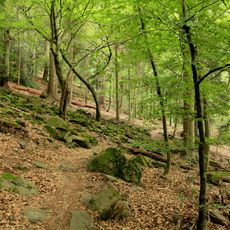
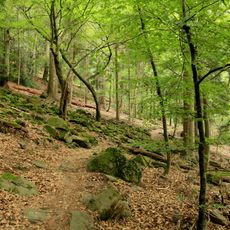
The tower stands about 500 metres northeast of the highest point of the Langenbrander Höhe, at 707 metres above sea level, on the Langenbrand district of Schömberg. It is not open to the public, so it can only be viewed from outside. The surrounding forest tracks of the northern Black Forest allow walkers to keep the 143-metre structure in sight as a landmark.
The steel lattice section is 126.8 metres tall; above it sits a 16-metre cylinder of glass-fibre-reinforced plastic housing the television antenna, which was replaced when DVB-T launched on 5 November 2008. The tower stands at 707 metres above sea level, about 500 metres northeast of the highest point of the Langenbrander Höhe.
The community of curious travelers
AroundUs brings together thousands of curated places, local tips, and hidden gems, enriched daily by 93,095 contributors worldwide.