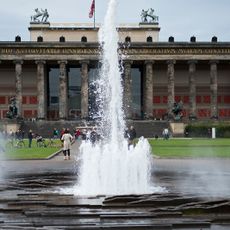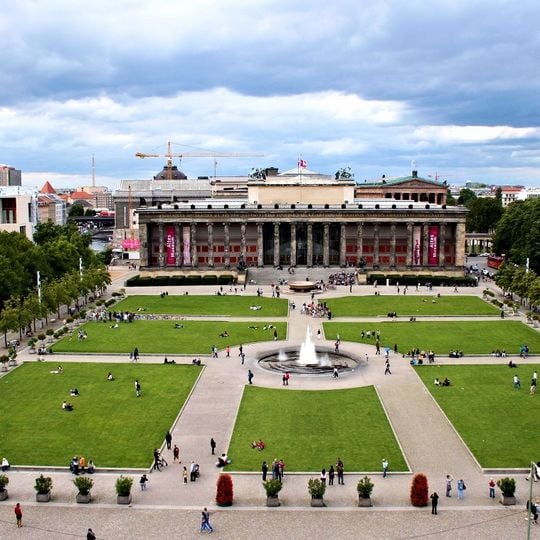
Lustgarten, Public garden on Museum Island, Berlin, Germany
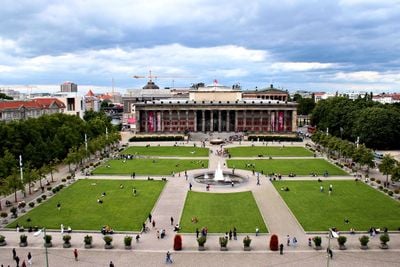
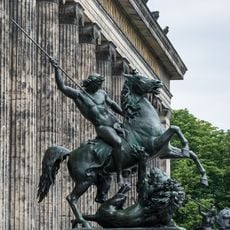
Lustgarten is a public garden on Museum Island in the Mitte district of Berlin. Open lawns and paths frame a central open space that serves as a meeting point and resting area.
The site was first mentioned in 1471 and was laid out in 1573 by Elector Johann Georg as a kitchen garden for the Berlin Palace, with court gardener Desiderius Corbinianus planting herbs and fruit trees. After the Thirty Years' War, Elector Friedrich Wilhelm had it rebuilt from 1645 as a Dutch-style pleasure garden, giving it the name Lustgarten in 1646. In 1713 Friedrich Wilhelm I turned it into a sand-covered parade ground. Between 1826 and 1829 Peter Joseph Lenné redesigned it with formal paths dividing it into six sectors and a central fountain powered by a steam engine.
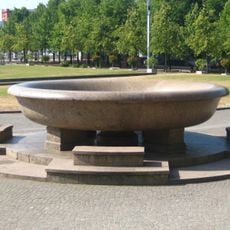
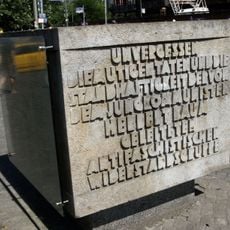
The name Lustgarten means pleasure garden, given in 1646 when the kitchen garden became a formal Dutch-style garden. A granite bowl placed here in 1834 is one of Berlin's best-loved landmarks. A 1981 memorial stone by Jürgen Raue recalls the Herbert Baum resistance group, which tried to destroy the Nazi exhibition The Soviet Paradise in 1942.
The garden remains freely accessible throughout the day and works well as a starting point for museum visits. During events access to certain sections may be temporarily restricted.
A huge granite bowl stands at the center of the square and weighs several dozen tons. It was transported here by water along the Spree because its weight was too great for the roads of that time.
The community of curious travelers
AroundUs brings together thousands of curated places, local tips, and hidden gems, enriched daily by 93,748 contributors worldwide.