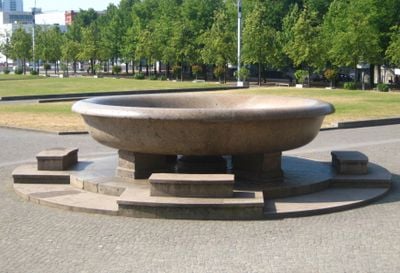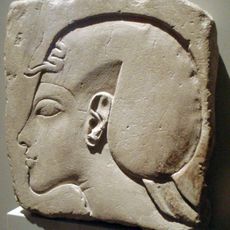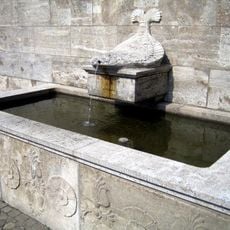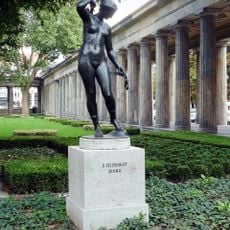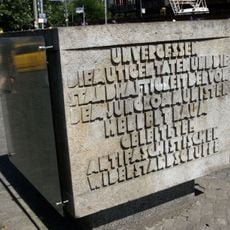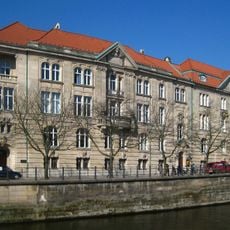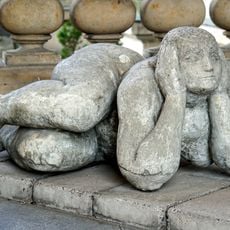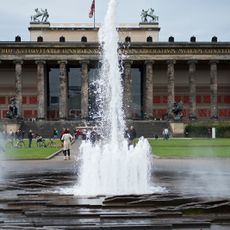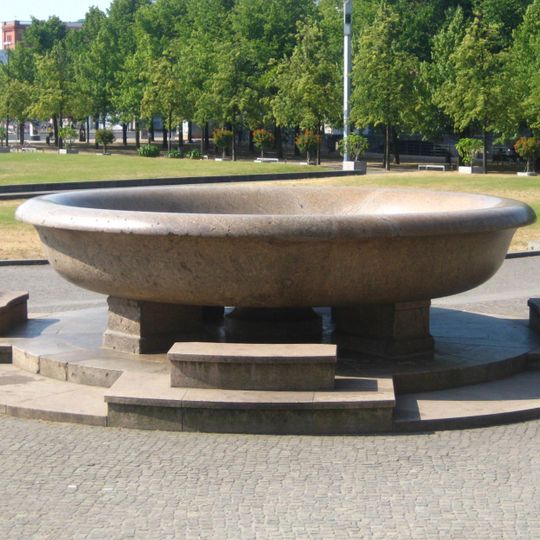
Granite bowl, Stone sculpture in Lustgarten, Germany.
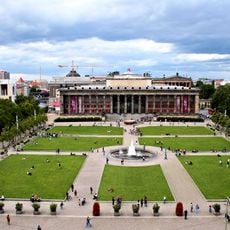
The Granite Bowl is a shallow circular basin of reddish-brown Karlshamn granite with grey speckling, 6.91 metres across and weighing about 75 tonnes, cut from a single block. It rests on four short rectangular stone supports on a stepped platform of fitted slabs, with a rectangular granite step block in front. It stands on the paved Lustgarten before the Altes Museum.
A Prussian king commissioned this work in the early 19th century to place it as a representative stone in front of one of the most important museums. Completion took several years and marked a high point of Prussian classicism.
Berliners nicknamed the bowl "die Suppenschüssel" (the soup bowl). In the Biedermeier period granite stood for firmness and steadfastness, and the bowl was read as a patriotic symbol; the painter Johann Erdmann Hummel recorded it in sketches and paintings. It belongs to the Deutsches Historisches Museum.
This artwork is located in the Lustgarten and can be viewed year-round without entering a museum. Its location in open grounds makes it easily accessible for visitors with different mobility needs.
The block came from Karlshamn in southern Sweden, carried to the Rauensche Berge moraine by the Saale or Weichsel glaciation; its red Karlshamn granite is about 1,420 million years old. Cantian first split a 600-tonne block near Neuendorf, but it proved too brittle, so he turned to the Großer Markgrafenstein, estimated at 700–750 tonnes.
The community of curious travelers
AroundUs brings together thousands of curated places, local tips, and hidden gems, enriched daily by 92,861 contributors worldwide.