Berlin glass amphora from Olbia, Hellenistic glass amphora in Berlin, Germany
The Berlin glass amphora from Olbia is 59.6 cm high, the largest surviving glass vessel of antiquity, made from two cast or pressed parts joined at a bulge hidden by a gilt copper strip with vine patterns. Satyr-shaped gilt copper spouts with animal bladders sit in drilled holes below the belly; the handles carry mask-and-scroll sleeves.
Created in the 2nd century BC, this vessel was discovered in Olbia on the northern Black Sea coast. Friedrich Ludwig von Gans donated it to Berlin's Antikensammlung collection in 1912.
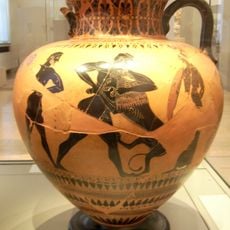
The shape follows Athenian Panathenaic prize amphorae, made in Athens in the 3rd and 2nd centuries BC. The gilt copper handle sleeves take the form of masks and maple scrolls, and the satyr-shaped taps held animal bladders. A wealthy citizen of Olbia likely commissioned the vessel, which was found there.
The amphora is in the Antikensammlung Berlin, displayed in the Altes Museum under inventory number 30219, 254. Look for the conical replacement cap, which overlaps the neck and is slightly more yellow than the body, and for the visible bulge where neck and mouth were joined. Only one side of the gilt copper strip covering the join between belly and shoulder survives.
The two halves of the vessel meet at a visible bulge, because the belly and the shoulder were shaped separately and joined with a hot stick. Only one side of the gilt copper strip that once masked this seam survives. The glass is milky yellow today, turned by centuries of sunlight from its original pale green.
The community of curious travelers
AroundUs brings together thousands of curated places, local tips, and hidden gems, enriched daily by 94,384 contributors worldwide.