Burg Heid, Medieval castle in Schillingen, Germany
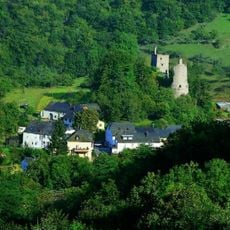
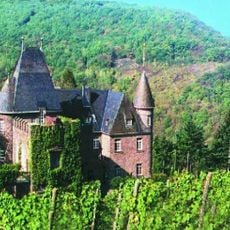
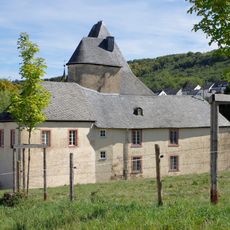
Burg Heid is a moated-style manor complex in Schillingen, Rhineland-Palatinate, not a ruin: two gate towers with helmet roofs flank an entrance gate bearing the von Nell zu Thomenacher coat of arms in sandstone, followed by a large round tower, a bergfried and a stable building of similar form. A half well-basin with shell ribs from the 18th century stands at the main building.
The estate arose in the 14th century on the Schillingen and Heddert boundaries and belonged to the Trier Cathedral Chapter in the 18th century. In 1804 the art collector Peter Job Hermes acquired it at auction; around 1850 his nephew Johann Peter Job Nell converted it into a manor and knight's estate, and the name Burg gradually took hold. In 1932 the von Nell family ended farming and Generaldirektor Achter of Mönchengladbach bought the property, now run by his grandson.
The name Heid comes from the Gutshof Heid, a estate built in the 14th century on Schillinger and Hedderter land; the name has no recorded pre-Christian sacred meaning. Since around 1850 the von Nell family's heraldic coat of arms has been carved in sandstone above the gate between the two gate towers, and it remains the most visible mark of the family that turned the farm into a knight's estate.
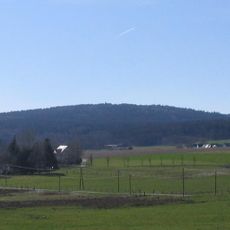
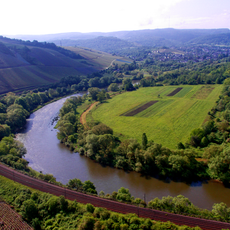
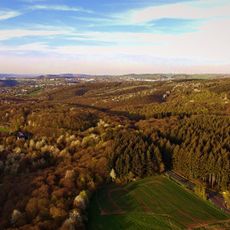
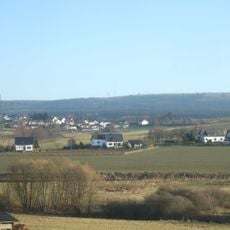
Burg Heid stands on the road between Lampaden and Heddert, on the territory of Schillingen, near the former Lampaden railway stop and the Heider Mühle. It is a privately run estate, still farmed by the owner's family, so the grounds are not a public visitor site; the gate, towers and courtyard are best seen from the public road. The site lies at about 330 m above sea level below the 530 m Heidkopf.
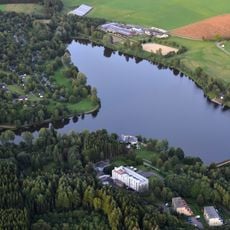
The pond laid out beside the estate suggests the manor once had the character of a water castle, and the coat of arms of the von Nell zu Thomenacher family carved in sandstone above the gate between the two gate towers points the same way. The half well basin with shell ribs on the front of the main building dates from the 18th century; its former well post was later replaced by a red sandstone pillar carrying a figure of the Mother of God holding the child on her right arm.
The community of curious travelers
AroundUs brings together thousands of curated places, local tips, and hidden gems, enriched daily by 94,002 contributors worldwide.