Buskam, Glacial erratic in Göhren, Germany
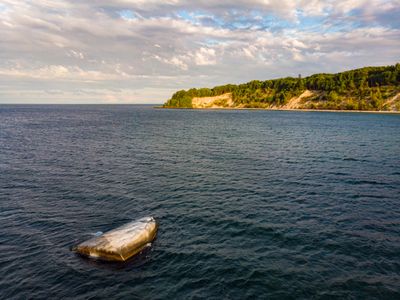
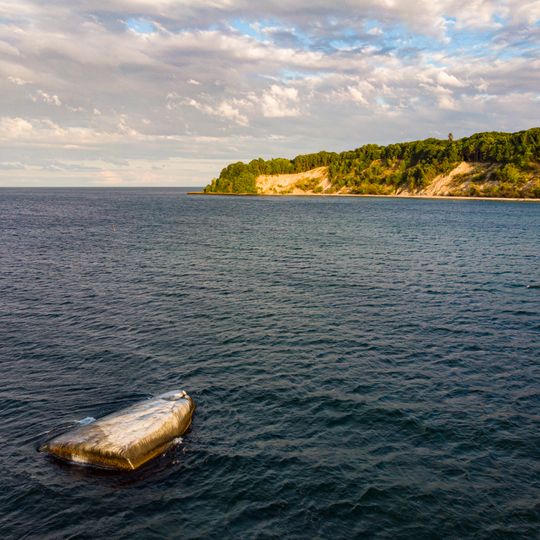
Buskam is a granite glacial erratic lying about 325 metres off the coast of Göhren on Rügen, one of the largest found in northern Germany. Its pale greyish-white upper surface, streaked with tan and darker tones, is smooth and worn, rising up to 1.5 metres above the waterline. Small cavities are cut into its top.
The Buskam was carried by the Scandinavian inland ice from Bornholm during the last ice age. In the Neolithic and probably the Bronze Age it still lay on land; only the Littorina transgression submerged its surroundings. Bronze Age users carved small hollows into its top, and after 1000 AD a metal cross was fixed to it.
The name Buskam comes from old Slavic words meaning God's stone. People gathered here during the Bronze Age to perform rituals and honor their beliefs.
The Buskam lies about 325 metres off the coast near Göhren, by the Nordperd. It is hard to reach by boat because other stones lie just below the water surface on the landward side. The boulder is often washed over even in moderate winds, so view it from the shore.
The Buskam is a Näpfchenstein: small hollows on its top surface mark its use as a ritual site in the Bronze Age. After Pomerania's conversion, an iron crucifix was fixed to the boulder. Local lore also makes it a meeting place for witches on Walpurgis Night and a dancing stone for mermaids.
The community of curious travelers
AroundUs brings together thousands of curated places, local tips, and hidden gems, enriched daily by 92,704 contributors worldwide.