St. Paul's Gate, Baroque gate in Fulda, Germany
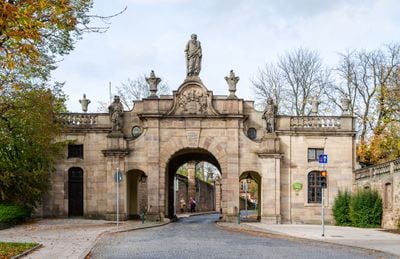
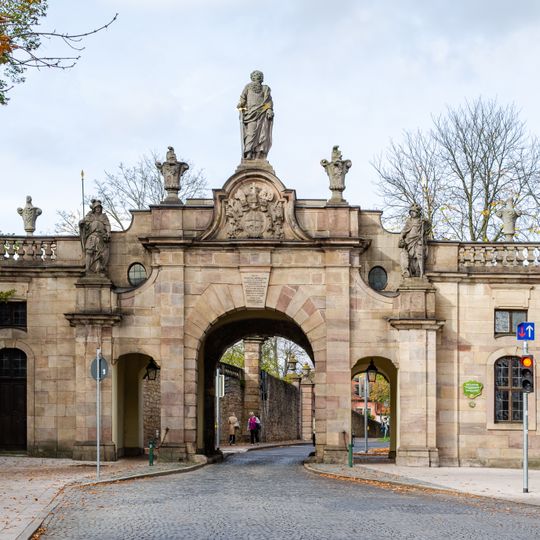
St. Paul's Gate is a Baroque passage structure in Fulda featuring thick stone walls and architectural details from the early 1700s. The construction displays typical characteristics of fortification entrances from this era, with a sturdy form that conveyed both protection and representation.
The gate was built from 1709 to 1711 to plans by Johann Dientzenhofer and first stood between the Stadtschloss and the Hauptwache. In 1771 building inspector Karl Philipp Arnd moved it to the end of the Pauluspromenade at the request of Prince-Bishop Heinrich von Bibra. Historian Werner Kirchhoff read this as a political gesture: von Bibra lifted the separation between monastery district and city, showing that former subjects were now citizens. In 1871 the city bought the gate from the state for 200 Reichstaler to prevent its demolition.
The gate is named after the apostle Paul, whose sandstone statue stands above the portal between the city patrons Simplicius and Faustinus. Simplicius, on the right, holds a spear, shield and cross; Faustinus, on the left, a spear, a shield with a lily and a half imperial eagle. The two figures, probably carved by Andreas Balthasar Weber, were meant as guardians of the city against enemies and defenders of the faith.
The gate stands at the end of the Pauluspromenade, a short walk from Fulda's cathedral quarter. It is a freestanding monument, so it can be viewed from all sides at any time; the sandstone figures above the portal face outward and are best seen from the promenade side.
The gate's survival was secured in 1871 when the city bought it from the state for 200 Reichstaler under mayor Franz Rang, preventing demolition. The sandstone figures of Simplizius and Faustinus, likely carved by Andreas Balthasar Weber, hold a spear, a shield and a cross; Faustinus's shield bears a lily and a half imperial eagle.
The community of curious travelers
AroundUs brings together thousands of curated places, local tips, and hidden gems, enriched daily by 93,434 contributors worldwide.