Huthpark, Public park in Seckbach, Frankfurt, Germany
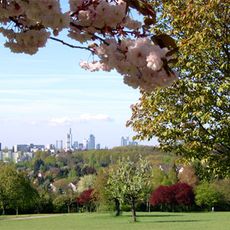
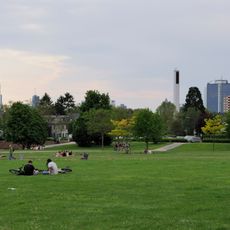
Huthpark is an 18.2-hectare public park laid out between 1910 and 1913 on a slope of the Berger Rücken in Seckbach, following designs by garden director Carl Heicke and garden architect Bernhard Rosenthal. The existing terrain was kept, so lawns, tree groups and curving paths follow the hillside; the Propst-Goebels-Weg crosses the grounds. A round pavilion of 1929/30 by Eugen Carl Kaufmann, Herbert Boehm and Eugen Blanck stands on the Propst-Goebels-Weg, its rotunda now glazed as a café.
Huthpark was laid out from 1910 to 1913 to designs by Frankfurt garden director Carl Heicke and garden architect Bernhard Rosenthal, and completed from 1912 under Max Bromme. It was the first of two planned public parks for Seckbach, which had been incorporated into Frankfurt in 1900; the second, Lohrpark on the Lohrberg, followed only after World War I. The existing terrain was kept, and the design followed the model of the Günthersburgpark.
The name Huthpark comes from an old field name, "Auf dem Huth", for the Seckbach farmland that preceded the park. In 1912 two residents of the Seckbach Heimgarten colony, nicknamed Tintenfass or Kanapee because of its many academics, asked a city councillor for permission to lay two tennis courts here; the city paid for them, a garden hut served as clubhouse, and the Tennisverein Heimgarten was founded the same year. In the 1920s and 1930s shepherds drove sheep flocks through the park to keep the lawns short.
The park lies between Seckbach's core and Friedberger Landstraße; the Propst-Goebels-Weg crosses it and links the Atzelberg area with the old centre around Wilhelmshöher Straße. The 1929 pavilion by Eugen Carl Kaufmann, glazed in the 2009–2012 renovation, holds a café with 45 indoor seats and a summer terrace, plus public toilets downstairs. Bus stops Eschweger Straße (lines 38 and 43) are nearby.
The park displays design features from early 20th-century garden planning, visible in how paths and green areas are carefully arranged as you walk through. These historical design elements remain noticeable in the park's everyday layout, even though how people use it has changed over time.
The community of curious travelers
AroundUs brings together thousands of curated places, local tips, and hidden gems, enriched daily by 93,942 contributors worldwide.