Elbebrücke Wittenberg, Railway bridge in Lutherstadt Wittenberg, Germany.
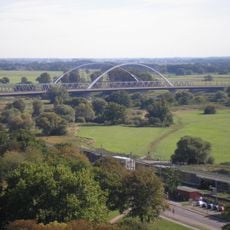
Elbebrücke Wittenberg is a 333.2 m two-track railway bridge on the Berlin–Halle line, crossing the Elbe at kilometre 96. Its three-field steel structure has a 156.8 m main span formed by a tied-arch truss with a 27 m high arch, flanked by two 88.2 m side spans; the 11 m high river piers widen upward in a bone shape, and a five-field prestressed concrete approach bridge about 140 m long continues to the north.
The first railway bridge over the Elbe opened in 1859 with the Bitterfeld line of the Berlin-Anhaltische Eisenbahngesellschaft, a wrought-iron structure with spans of about 20 m. In 1888 two 43 m truss girders replaced four river fields; the eight flood fields followed in 1906 and the two long river spans in 1926. German troops destroyed the long superstructures in April 1945; a temporary bridge restored rail traffic that July, Roth-Waagner steel spans followed in 1947, and new truss superstructures in 1965.
The bridge carries the Berlin–Halle line, part of the Verkehrsprojekt Deutsche Einheit No. 8.3 upgrade, and stands beside a road bridge built at the same time. Its 2000 opening shifted the railway about 350 m upstream, so the crossing now sits next to the road crossing on the Elbe meadows.
The bridge carries the Berlin–Halle line at kilometre 96, with a permitted maximum speed of 160 km/h. The railway crosses at an angle of about 62 gon, and the northern edge field curves to follow the relocated alignment. The structure stands about 350 m upstream of the old crossing; the parallel road bridge runs alongside it.
In 2001, a modified suspension system was installed using specialized welding techniques to reduce wind vibration. This adaptation makes it an interesting example of engineering solutions against natural forces.
The community of curious travelers
AroundUs brings together thousands of curated places, local tips, and hidden gems, enriched daily by 94,561 contributors worldwide.