Feste Kaiser Alexander, Prussian fortress in Koblenz, Germany.
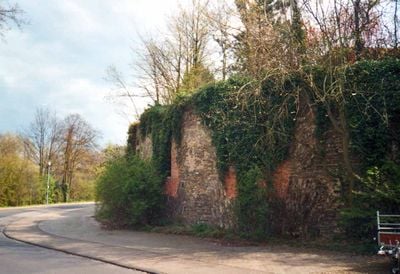
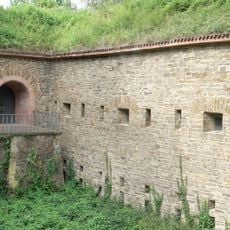
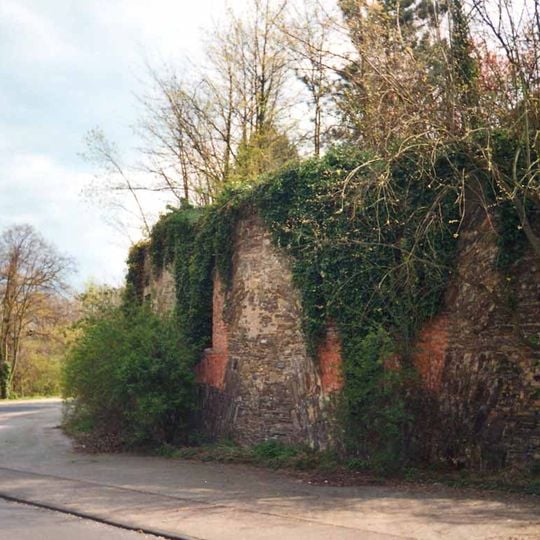
Feste Kaiser Alexander is a former Prussian fortress on the Karthause in Koblenz, completed in 1824. Its surviving Löwentor, the classicist main gate, stands beside a long wall of rough grey and brown stone with red brick patches, its upper part overgrown with ivy. The gate and a stretch of wall are all that remain of a work once among Europe's largest single fortresses.
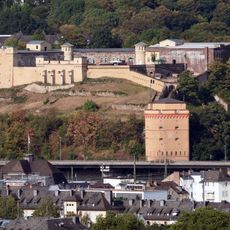
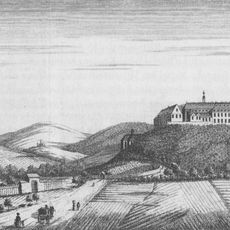
Construction of the fortress on the Hunnenkopf, a spur of the Hunsrück at 170 metres, began on 3 September 1816 under the engineer Claudius Franz Le Bauld de Nans. On 24 November 1818 King Frederick William III named it after Tsar Alexander I during a visit. Parts were occupied by 1822, completion was reported to Berlin on 2 April 1824, and the underground passage to Fort Großfürst Konstantin was finished in 1831. In 1922 the works were demolished, leaving only the Lion Gate and the redoubt.
The fortress shows how Prussian builders mixed strength with design when they created military structures in the 1800s. The Lion Gate stands out with its cast iron griffins and classical stone work, marking the entrance where soldiers and officials once passed through daily.
Only the Löwentor gate and a stretch of wall between it and the former redoubt survive; the rest of the fortress was levelled in 1922. The site lies on the Karthause plateau southwest of the city centre at about 170 metres. The gate fronts a paved road, and the wall above it is overgrown with ivy.
The 1831 underground passage to Fort Großfürst Konstantin was only part of the story: after the 1922 demolition, 136,000 m³ of masonry rubble were hauled away by a narrow-gauge railway and a steam shovel, and 182,000 m³ of earth were moved. Only the Lion Gate, the reduit and the wall between them survived.
The community of curious travelers
AroundUs brings together thousands of curated places, local tips, and hidden gems, enriched daily by 94,355 contributors worldwide.