Hübeling Blockhouse, Military blockhouse in Koblenz, Germany.
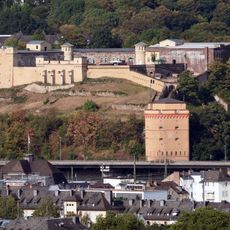
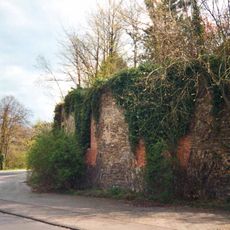
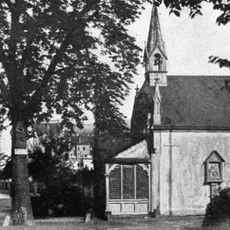
The Hübeling Blockhouse is a casemated blockhouse with a two-storey masonry gun tower built into a slope about 350 metres below Feste Kaiser Alexander. Its front faces south, the entrance is on the upper floor, and a masonry ditch surrounds the structure. The roof carries about 2.5 metres of earth cover.
Built between 1828 and 1830 as a defensive powder magazine, the Hübeling battery was a small detached work of the Prussian fortress Koblenz, covering the right flank of Feste Kaiser Alexander and the dead angle below it. It was armed with eight to ten guns and mortars plus an infantry detachment. Abandoned in 1903 and leased to the city, it was spared demolition after World War I because the Interallied Military Control Commission saw no military use; the Koblenz office argued demolition would disturb the neighbouring main cemetery. From 1954 to 1956 it was converted into a memorial.
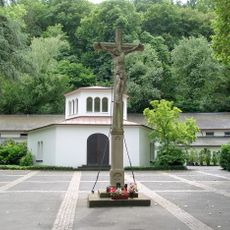
Since 1954–1956 the battery has served as Koblenz's memorial for the dead of the Second World War, redesigned by garden architect Hans Wilhelm Mutzbauer. Four grave fields with ceramic plaques and groups of three short-armed crosses surround it, and the painter and sculptor Eugen Keller created the bronze angel in the hall, pointing one hand to heaven and the other to earth.
The blockhouse sits on a hillside near the Rhine and can be reached on foot via paths in the surrounding area. Visitors should wear sturdy shoes since the terrain is hilly and the structure can be viewed from the outside.
The upper floor was reached by a movable bridge that lay within the firing line of the rear loopholes; it was later replaced by a fixed bridge. The lower floor front served as a gallery with openings for mortars.
The community of curious travelers
AroundUs brings together thousands of curated places, local tips, and hidden gems, enriched daily by 93,010 contributors worldwide.