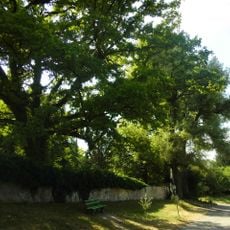
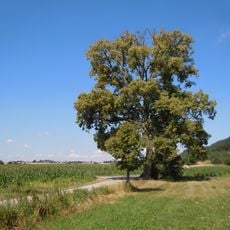
Schloss Bühl, Renaissance castle in Bühl, Tübingen, Germany
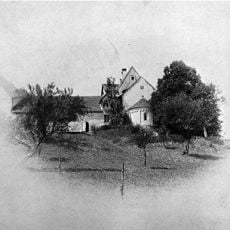
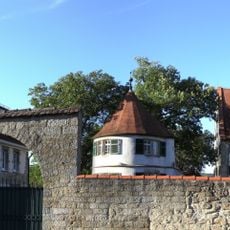
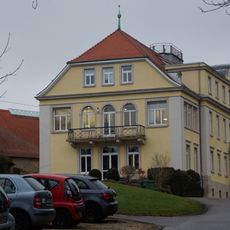
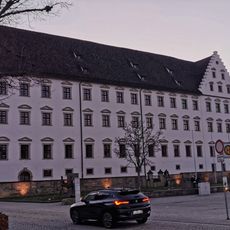
Schloss Bühl is a Renaissance building of 1554, erected by David vom Stain at the western edge of Bühl, now part of Tübingen. It is a three-storey stone house with a tall gabled roof; its narrow south side is timber-framed, and two round towers on the field side rise no higher than the roof. A continuous narrow stone frieze runs between the storeys, and a timber-framed oriel sits at the south-west corner.
David vom Stain built the Renaissance castle in 1554 on the western edge of Bühl. In 1628 his son Leopold Carl vom Stain sold the estate to Austria, and Emperor Leopold I passed it to the Rottenburg Jesuit college against a loan of 10,000 gulden. The order ran a brewery there until 1924; after 1773 the building also served as an inn and changed owners often. Tübingen lawyers bought it at auction in 1980 and converted it into condominiums.
The stone lion masks on the north gable, probably moved there from an earlier gatehouse, served as the model for the wooden masks of the Bühl Narrenzunft, the local carnival guild. A dance licence (Tanzgerechtigkeit) recorded for the castle brewery in 1807 still exists today.
Schloss Bühl stands at the western edge of the Bühl district; the site is now divided into privately owned flats, so the building itself is not open to visitors. From the surrounding lanes the three-storey stone house, its two round flanking towers and the timber-framed south gable can be seen from outside. The outlines of the former economic yard with its long barns and stables are still legible on the north and east sides.
The stone lion masks on the north gable wall were probably moved here from a former gatehouse; they served as the model for the wooden masks of the Bühl Narrenzunft, the local carnival guild. The two round towers on the field side do not rise above the main roof.
The community of curious travelers
AroundUs brings together thousands of curated places, local tips, and hidden gems, enriched daily by 94,408 contributors worldwide.