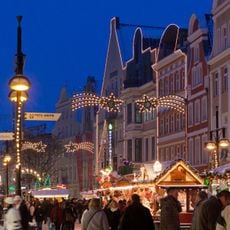
Kröpeliner Straße, Shopping street in central Rostock, Germany.
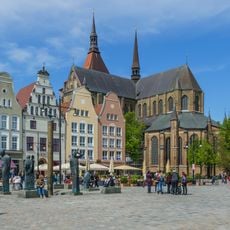
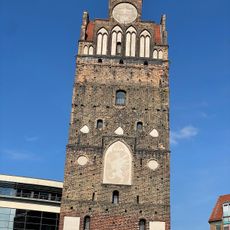
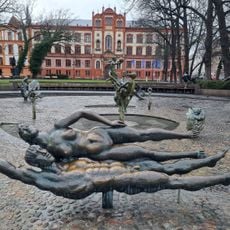
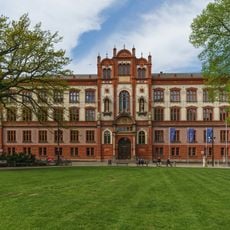
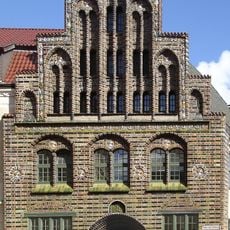
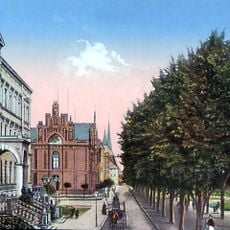
Kröpeliner Straße is Rostock's main shopping street, running 650 metres east–west from Neuer Markt to Kröpeliner Tor. It is lined with 40 listed buildings in styles from Hanseatic brick Gothic and Renaissance to Baroque, classicism, historicism and postmodernism. At its midpoint lies University Square with the university's main building and the Fountain of Joy of Life; the Ratschow House, the only building here with a Gothic brick façade, now houses the city library.
Until 1945 only the western section by the Kröpeliner Tor was called Kröpeliner Straße; the rest was Hopfenmarkt and Blutstraße, the latter from Low German "blot" for unpaved. From 1945 the whole stretch bore one name, as Stalinstraße until de-Stalinisation, then Kröpeliner Straße again. Horse trams ran here from 1881, electric from 1904; on 20 May 1961 the tracks were moved to the parallel Lange Straße, and in 1968 the street became one of the GDR's first pedestrian zones.
The name's origin is disputed: it may refer to the town of Kröpelin west of Rostock or to a patrician family of that name. Until 1945 only the western section was called Kröpeliner Straße; the eastern part was Blutstraße, from Low German "blot" meaning unpaved. The Ratschow-Haus, a Gothic brick gable house, has housed the city library since 1961.
The street is easy to walk through with level paving and regular seating areas providing rest stops along the way. Visitors will find a mix of retail chains, independent shops, and cafes open throughout the year for food or shopping.
The Ratschow-Haus, at the street's heart, is the only building here with a Gothic brick facade; its stepped gable with pinnacles, glazed stones and terracotta medallions of biblical scenes survived a 1945 fire, and the house was rebuilt behind the old gable from 1950. Since 1961 it has housed the city library.
The community of curious travelers
AroundUs brings together thousands of curated places, local tips, and hidden gems, enriched daily by 94,229 contributors worldwide.