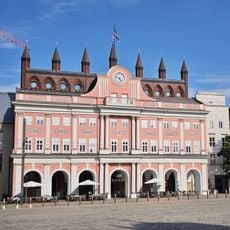
University of Rostock main building, University main building in Rostock, Germany
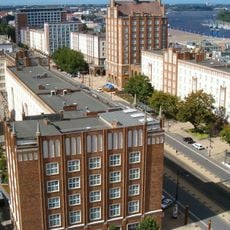
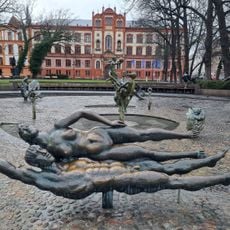
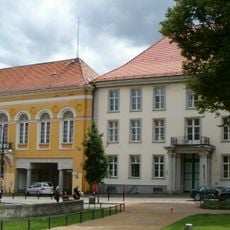
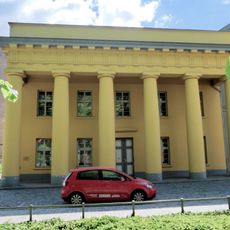
The University of Rostock main building is a Mecklenburg Neo-Renaissance structure on Universitätsplatz, built 1867–1870 to a design by Hermann Willebrand. It combines the 1870 main building, the 1844 Neues Museum and an 1827 courtyard wing. The five-storey main block has a central risalit with the entrance portal, vestibule and Aula above; the ground floor is rusticated with terracotta-red paint.
The site has belonged to the university since its founding in 1419, when the Große Kollegium was built; it burned in 1565 and was replaced in 1567 by the Weißes Kollegium, named for its white paint by 1649. After the old building was demolished in 1866, Hermann Willebrand designed the present structure, whose foundation stone was laid in March 1867 and which opened on 27 January 1870. The adjoining Neue Museum wing dates from 1844 and was designed by Georg Adolph Demmler.
The building's picture programme was devised by Georg Christian Friedrich Lisch, who placed four portrait medallions of Galileo Galilei, René Descartes, Otto von Guericke and Carl von Linné on the first floor of the New Museum wing. They stand for the natural sciences and the university's orientation beyond Mecklenburg.
The building is located at Universitätsplatz in the heart of Rostock and can be easily reached by walking through the surrounding streets. Most areas are accessible during standard hours, though some wings may have restricted access depending on university activities.
Four portrait medallions on the first upper floor of the New Museum wing honour Galileo Galilei, René Descartes, Otto von Guericke and Carl von Linné, signalling the natural sciences. The building's layout also joins three parts of different heights: the 1827 court annex with three storeys, the 1844 New Museum with four, and the 1870 main building with five.
The community of curious travelers
AroundUs brings together thousands of curated places, local tips, and hidden gems, enriched daily by 94,303 contributors worldwide.