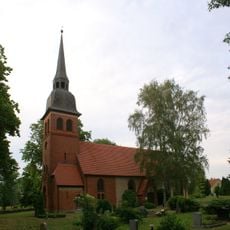
Water castle Quilow, Renaissance fortified house in Groß Polzin, Germany
Wasserschloss Quilow is a two-storey Renaissance manor house with a rectangular plan, built from the 1560s to about 1575 for Roleff von Owstin on a medieval motte. Its cellars and ground floor keep cross-vaulted ceilings, the walls are rendered mixed masonry on fieldstone foundations, and the roof carries the last surviving dormer gables (Zwerchhäuser) over a south facade in Vorpommern.
Quilow was first recorded in 1172 as "villa Quilowe", when Duke Bogislaw I of Pomerania granted the village to Stolpe Abbey; the Renaissance house stands on a medieval motte of the 12th to 14th century. Roleff von Owstin, who inherited the estate in 1550, built the present house, begun in the 1560s and finished by about 1575. From 1648 to 1815 Quilow belonged to Swedish Pomerania; in 1858 the estate passed by lot to the von Ploetz family, and in 1945 Claus von Ploetz was expropriated in the land reform.
The name Quilow appears in 1172 as "villa Quilowe", when Duke Bogislaw I of Pomerania gave the village to Stolpe Abbey. The Renaissance hall on the ground floor now serves food and drink, while the upper floor hosts events. The first floor, only partly restored, holds an exhibition on the building's history.
The castle reopened in summer 2020 after about ten years of preparation and three years of construction, and has been open to visitors since. The ground-floor Renaissance hall now serves food and drink, while the upper floor is only partly restored and holds an exhibition on the building's history. The moat is dry and largely filled in.
During the restoration, traces of past repairs and modifications were deliberately left visible so that the building's history can be read directly on its walls. Visitors can follow the different phases of construction with their own eyes as they walk through.
The community of curious travelers
AroundUs brings together thousands of curated places, local tips, and hidden gems, enriched daily by 94,226 contributors worldwide.