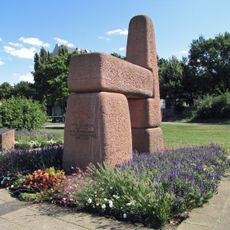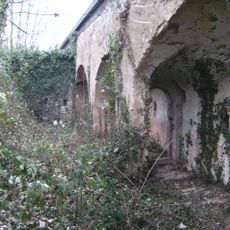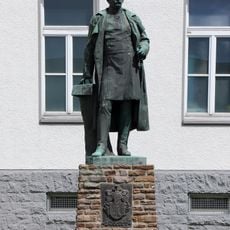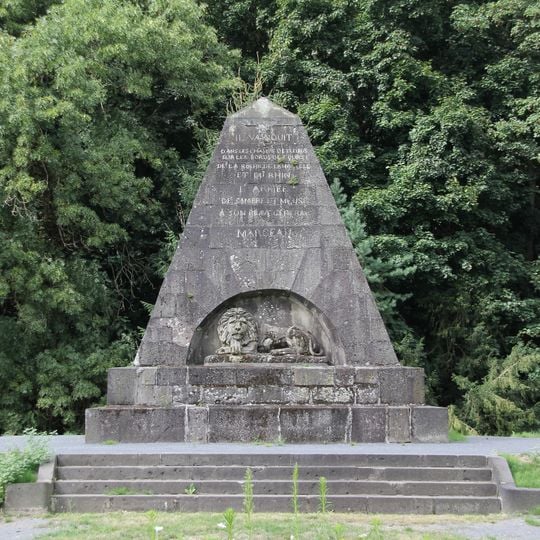
Marceau-Denkmal, Memorial monument in Lützel district, Koblenz, Germany.
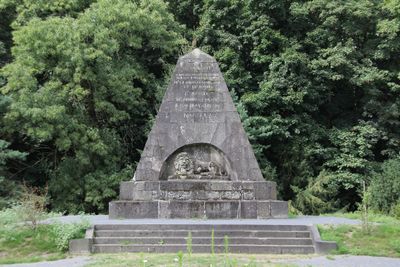
The Marceau Monument is a truncated pyramid of Mendig basalt lava on a four-step pedestal, located on the Franzosenfriedhof in Koblenz-Lützel. Its front features a semicircular niche with a relief of a crouching lion, and the lower edge design with lunette field follows a tomb design by Parisian architect Étienne-Louis Boullée. The four sides bear French inscriptions describing Marceau's life and deeds.
Marceau was mortally wounded at Höchstenbach on 19 September 1796 and died two days later in Altenkirchen. He was buried with military honours on 25 September 1796 at the northern end of the Petersberg. In 1797 his friend General Kléber funded a pyramid by Peter Joseph Krahe and Georg von Trosson; it was dismantled in 1817 for the Bubenheimer Flesche and rebuilt in 1818 at its present site.
The monument displays inscriptions on its sides that tell the story of General Marceau and his role in history, showing the shared memory between France and Germany. These texts help visitors understand the connection between two nations during a turbulent time.
The monument stands on the Franzosenfriedhof in Koblenz-Lützel, at the foot of the Petersberg; the site is reached via Am Franzosenfriedhof. The pyramid was rebuilt here in 1818 after its stones had been taken for the Bubenheimer Flesche, and the lowest pedestal step remains lower because those stones were not replaced. The lion relief visible today is a 1885 replacement by sculptor Philipp Bohl.
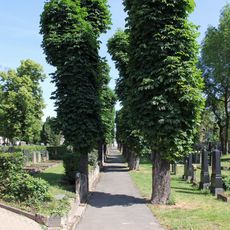
The monument sits within a cemetery created specifically for French prisoners of war who died during the 1870/71 conflict, making it much more than just a tribute to one general. This layering of history shows how individual soldiers were remembered alongside the commander.
The community of curious travelers
AroundUs brings together thousands of curated places, local tips, and hidden gems, enriched daily by 94,042 contributors worldwide.