Balduinbrücke, Medieval stone arch bridge in Koblenz, Germany
The Balduinbrücke is a stone arch bridge over the Moselle in Koblenz, built from Devonian greywacke and volcanic basalt lava. Its 14th-century construction began around 1342/1343 under Archbishop Baldwin of Luxembourg and was completed in 1429 with the Torturm. Originally 14 arches and 325 metres long, it now has a modern prestressed concrete section over the shipping canal and is about twice as wide as in the Middle Ages.
Construction began around 1342/1343 under Archbishop Baldwin of Luxembourg, with a charter dated 1 May 1343; the bridge was completed in 1429 with the building of the gate tower. It was blown up on 7 March 1945 and rebuilt between 1946 and 1949. In the 1960s six arches on the Lützel side were demolished for the Moselle canalisation.
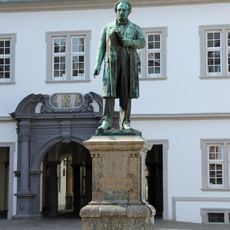
The bridge is named after Baldwin of Luxembourg, Archbishop-Elector of Trier, under whom construction began in 1343. A stone figure by sculptor Rudi Scheuermann on the bridge commemorates him. In the archway on the Koblenz side hang a Christ the King relief carved in the 1970s by Siegfried Erdmann and an 18th-century inscription tablet naming a former bridge master.
The bridge is easily accessible on foot and offers a stable crossing over the Moselle for walkers. It can get crowded during peak times, so visiting during quieter hours makes for a more comfortable stroll.
Six of the original fourteen arches on the Lützel side were demolished in the 1960s to make room for the Moselle shipping canal, and a modern prestressed concrete span now crosses the canal. The surviving arches were widened by about five metres, so the bridge is roughly twice as wide as in the Middle Ages.
The community of curious travelers
AroundUs brings together thousands of curated places, local tips, and hidden gems, enriched daily by 94,455 contributors worldwide.