Villa Beck, Neoclassical villa in Biebrich, Germany
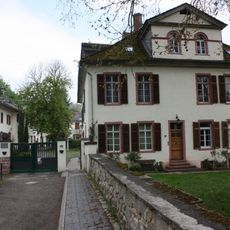
Villa Beck is a neoclassical residence in the Biebrich district of Wiesbaden with a symmetrical two-story structure. The building features a three-story central projection topped by a flat triangular pediment, maintaining the classical language of 19th-century design.
Villa Beck was designed by architect Wilhelm Bogler and built between 1869 and 1872 for clockmaker Hubertus Kreitz, who had settled in Saint Petersburg in 1837 and made his name there with costly calendar clocks. After Kreitz's death, ironworks specialist Ludwig Beck, owner of the Nassauische Rheinhütte since 1869, bought the villa in 1898 and completed his five-volume work Die Geschichte des Eisens here. Karl Henrici remodelled it in 1926, Hans-Peter Mallon in 2005.
The villa is a station on the Route der Industriekultur Rhein-Main, a driving route linking industrial heritage sites in the Rhine-Main region. Its name recalls the Beck family, owners of the Nassauische Rheinhütte ironworks from 1869; Ludwig Beck bought the house in 1898 and wrote his five-volume Die Geschichte des Eisens here.
The property is located at Rheingaustraße 138 in the Biebrich district and is not open to visitors since it remains a private residence. The neoclassical architecture can be viewed from the street.
The middle of Ludwig Beck's three sons, also named Ludwig, chose a military career in 1898, became a colonel general, and was executed in 1944 as a resistance fighter. The villa's owner from 1898 was the iron specialist Ludwig Beck, who completed his five-volume work Die Geschichte des Eisens here.
The community of curious travelers
AroundUs brings together thousands of curated places, local tips, and hidden gems, enriched daily by 93,358 contributors worldwide.