Wolfsbrunnen, Water well and cultural monument in Heidelberg, Germany.
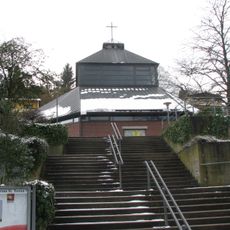
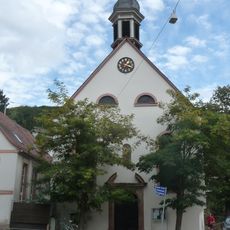
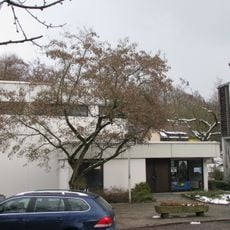
Wolfsbrunnen is a historic spring complex in Heidelberg-Schlierbach, set in a steep valley below the Königstuhl. Elector Friedrich II had a pleasure house with fountains and water features built here around 1550; three fish ponds once existed, and the pond below the restaurant survives from the upper one. The main building was extended with north and south annexes between 2011 and 2015.
Around 1550 Elector Friedrich II had a pleasure house with fountain and waterworks built in the Schlierbach valley; three fish ponds also belonged to it, partly visible today. The spring was already mentioned in a document of 1465 as the property of the Palatine counts' Wolfskreiser. The restaurant closed in early 2008 and reopened on 1 May 2015 after two extensions.
The name likely derives from the electoral Wolfskreiser, the official who drove out and caught wolves. A legend tells that the pagan seer Jetta was torn apart by wolves at the spring; Martin Opitz wrote a sonnet on her fate, which was said to be fulfilled here. In 1807 Joseph von Eichendorff described the overgrown site as having a "magical dark stillness".
The site lies about two kilometres east of Heidelberg Castle, reached via the old ridge path now called Schloss-Wolfsbrunnenweg. The restaurant reopened on 1 May 2015 after seven years of closure, following construction of north and south extensions from 2011 to 2015. The northern extension holds a large dining and events room.
The pond below the restaurant is the upper one of three fish ponds that once belonged to the complex; traces of the others can still be made out. Several springs around the fountain, including the Felsenmeerquelle, still supply drinking water for Heidelberg today.
The community of curious travelers
AroundUs brings together thousands of curated places, local tips, and hidden gems, enriched daily by 94,531 contributors worldwide.