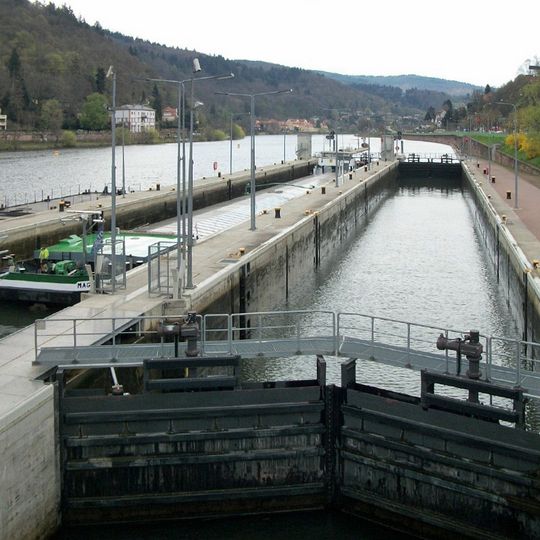
Staustufe Heidelberg, Lock and barrage in Heidelberg and Dossenheim, Germany
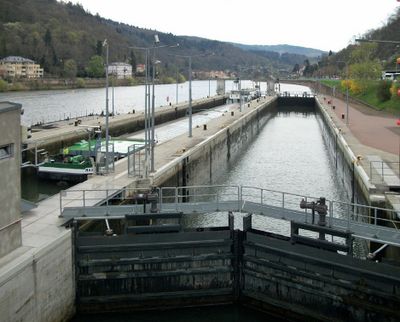
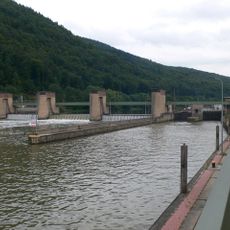
The Staustufe Heidelberg is a lock and barrage spanning 170 meters across the Neckar River, supported by four block pillars and equipped with three large gates for water management. Two lock chambers, each 110 meters long and 12 meters wide, allow vessels to pass through the waterway.
The barrage was built as part of the Neckar canalisation project led by Otto Konz. Strong local opposition feared damage to Heidelberg's historic townscape, so Paul Bonatz proposed in 1926 a design with a low weir footbridge on the upstream side and full natural-stone cladding, which calmed opponents. His recommendations were applied to later Neckar barrages until Aldingen. The plant was expanded between 1996 and 1998 with a power station on the right bank.
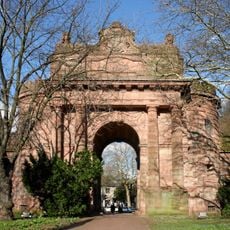
Paul Bonatz's 1926 design used low buildings and full cladding in regional red Neckar Valley sandstone so the weir would sit lightly beside Heidelberg's old town. The same recommendations were applied to later Neckar barrages until the Aldingen lock, where they were abandoned. The complex is a protected monument.
The facility is visible from surrounding paths and viewpoints scattered around the area. Visiting during daylight hours makes it easier to observe the construction details and the texture of the sandstone exterior from multiple angles.
Between 1996 and 1998, an underwater power plant with flow turbines was installed to generate electricity without altering the facility's surface appearance. This solution demonstrates how technical improvements can be seamlessly integrated into existing infrastructure without visual disruption.
The community of curious travelers
AroundUs brings together thousands of curated places, local tips, and hidden gems, enriched daily by 93,891 contributors worldwide.