Hortus Palatinus, Baroque garden at Heidelberg Castle, Germany
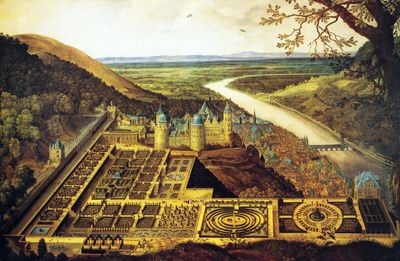
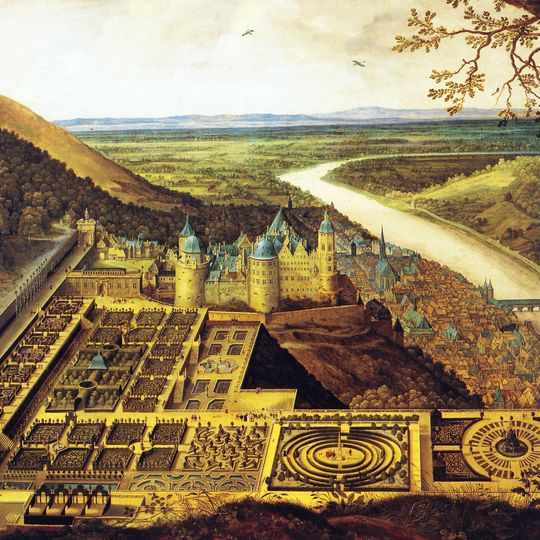
The Hortus Palatinus is a terraced garden at Heidelberg Castle, built from 1614 for Frederick V and Elizabeth Stuart. Its geometric parterres descend in pale yellow, tan and green levels, linked by broad flights of steps. Low hedges and gravel walks border the beds; a square enclosure holds a small blue pyramid fountain, and a circular maze of concentric rings surrounds a central basin beside a rectangular hedge labyrinth. Fortified walls and blue-green domed towers close the lower end.
The garden was created in 1614 as a gift from Elector Frederick V to his wife Elisabeth Stuart, designed by French engineer Salomon de Caus. Wars in the 1600s destroyed much of it, though portions of the original layout remain visible today.
The garden reflects how people of the era valued exotic plants and technical ingenuity, inviting visitors into the world of early modern aristocratic life. Ornamental areas once served as places where art, nature, and scientific curiosity met.
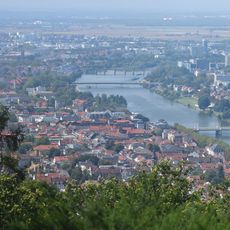
You can visit the preserved terraces year-round and enjoy views across Heidelberg and the Neckar Valley. The site is hilly and uneven, so sturdy shoes are helpful and some paths require moderate fitness.
Salomon de Caus, who could not speak German, published his own illustrated account of the garden; its preface is dated 20 December 1619 and written in French. The garden also held a recreation of the legendary animated statue of Memnon and a grotto praised in its day.
The community of curious travelers
AroundUs brings together thousands of curated places, local tips, and hidden gems, enriched daily by 92,787 contributors worldwide.