Andernach Geyser, Cold-water geyser in Andernach, Germany.
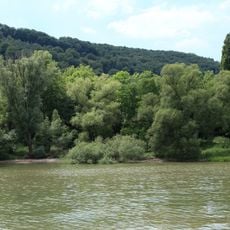
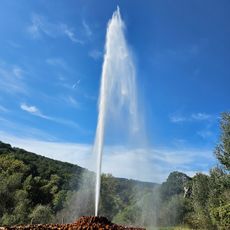
Andernach Geyser is a cold-water geyser on the Namedy Peninsula in the Rhine, fed by an artesian well from a depth of 350 meters (1,150 feet). The fountains shoot upward at intervals of roughly two hours and can reach anywhere between 30 and 60 meters (100 to 200 feet), depending on gas pressure.
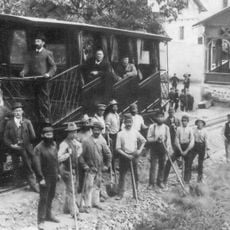
A 343-metre borehole was drilled on the Namedy Peninsula in 1903 after CO2 bubbles were seen rising in an old Rhine arm; the well erupted to 40 metres and its water was bottled as Namedyer Sprudel. The site was taken out of operation in 1957 and the borehole sealed with a valve in 1967. After a new borehole in 2001 and an out-of-court settlement with BUND in May 2005, eruptions resumed on 7 July 2006.
The geyser was long known as Namedyer Sprudel, after the Namedy peninsula where it rises; the bottled mineral water sold under that name made it a landmark. Since 2009 the passenger ferry Namedy has carried visitors from Andernach to the landing stage, and the boat was christened with that name during the opening celebrations.
The visit begins at the museum on the Rhine waterfront, where a tour explains how the eruptions occur before the boat departs for the peninsula. The total duration is about three hours, and comfortable shoes are recommended for the paths around the landing area.
The water from the well maintains a constant temperature of about 20 degrees Celsius (68 degrees Fahrenheit) because it is pushed upward by volcanic gas rather than heat. This characteristic sets the eruption apart from hot springs in Iceland or North America.
The community of curious travelers
AroundUs brings together thousands of curated places, local tips, and hidden gems, enriched daily by 92,634 contributors worldwide.