Königstor, City gate in Stuttgart, Germany
The Königstor is a city gate in Stuttgart featuring thick stone walls and characteristic architectural elements from the early modern period. The structure includes passage openings and arches that emphasize its historical function as a control point.
The Königstor was the last city gate built in Stuttgart, begun in 1809 and inaugurated in 1810 under King Friedrich. The design is attributed to Leopold Retti, with Nikolaus Friedrich von Thouret carrying out the construction. On 13 July 1814 Crown Prince Wilhelm rode through the gate, decorated with a large floral wreath reading SALVE, after the campaign against Napoleon. Perceived as a traffic obstacle after the main station was built, the gate was demolished in 1922.
The gate's name refers to King Friedrich, who took the royal title in 1806 and had the lower Königstraße laid out. On 13 July 1814 Crown Prince Wilhelm, later King Wilhelm I, rode through the gate after the campaigns against Napoleon; it was hung with a huge floral garland reading "SALVE". The gate was demolished in 1922.
The gate no longer stands: it was demolished in 1922, so there is nothing to walk through at the end of the lower Königstraße. Surviving fragments are kept at the central stairway of Stuttgart's main station and in the Städtisches Lapidarium, where one of the weapon trophies from the roof corners is preserved.
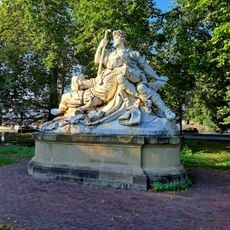
The gate's four roof corners carried trophies: two lion trophies from the Outer Esslingen Gate faced inward, two weapon trophies outward. One of the weapon trophies survives in the Stuttgart Municipal Lapidarium, while other remains are set into the main station's central stairway.
The community of curious travelers
AroundUs brings together thousands of curated places, local tips, and hidden gems, enriched daily by 92,875 contributors worldwide.