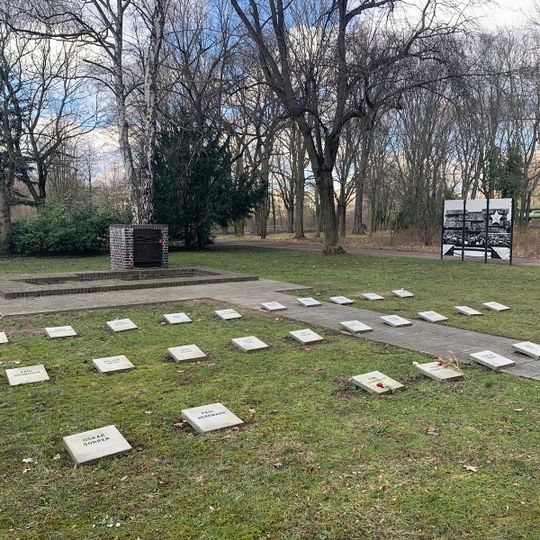
Revolutionsdenkmal, Memorial monument in Friedrichsfelde, Germany.
The Revolutionsdenkmal in Zentralfriedhof Friedrichsfelde is a cubic structure made of clinker bricks with rectangular blocks and distinctive geometric form. The work consists of interlocking elements that display a clearly recognizable modern formal language.
The monument was designed by Mies van der Rohe after Eduard Fuchs rejected a previous design as a "banker's monument". It was built by workers of the Bauhütte Berlin in spring 1926, unveiled unfinished on 13 June 1926, and formally inaugurated on 11 July 1926. The Nazis removed the star in February 1933 and demolished the structure to its foundations in 1935; it was never rebuilt.
The monument was unveiled on 13 June 1926, still unfinished for lack of funds, and formally inaugurated on 11 July 1926. Until 1933, annual Liebknecht-Luxemburg commemorations were held at the cemetery near the memorial. The planned inscription "Ich war, ich bin, ich werde sein" was never executed; the steel star was assembled from five ordered rhombi.
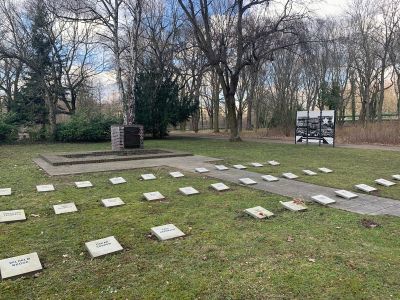
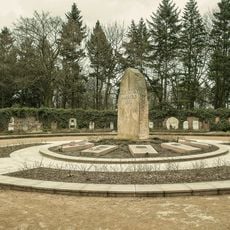
The monument no longer exists: only its foundation remains at Friedrichsfelde Central Cemetery, and since 1982 a memorial has stood on the spot. The graves of Liebknecht, Luxemburg and other militants were levelled in 1935. The site lies in the Lichtenberg district and can be reached on foot through the cemetery grounds.
The monument was financed mainly by selling postcards, and it was unveiled on 13 June 1926 while still unfinished because the collected money was not enough; the clinker brickwork was completed and formally inaugurated on 11 July 1926. The planned steel KPD star was replaced by five assembled rhombi, and the inscriptions "Den Toten Helden der Revolution" and "Ich war, ich bin, ich werde sein" were never executed.
The community of curious travelers
AroundUs brings together thousands of curated places, local tips, and hidden gems, enriched daily by 92,635 contributors worldwide.