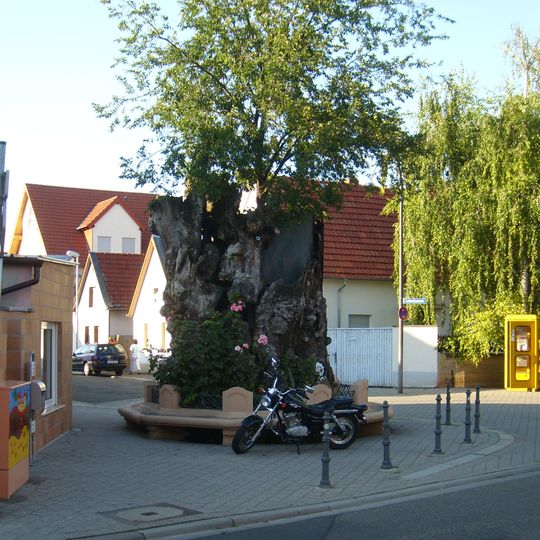
Lutherbaum, Field elm monument in Worms-Pfiffligheim, Germany
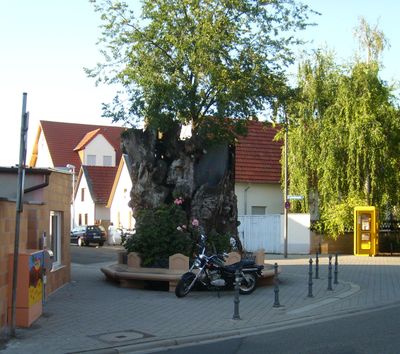
The Lutherbaum in Worms-Pfiffligheim is the torso of a field elm, probably planted in the early 16th century, now protected as a monument. Its remains, a stone bench, and a relief carved by Gustav Nonnenmacher from its wood stand behind a fence. Before losing its crown in 1870, the elm was over 30 m tall with a 9 m circumference.
The field elm was probably planted in the early 16th century; its age is not documented. On 26 October 1870 a storm broke about two thirds of the trunk, and after the soil was dug and fertilised the stump sprouted again. In 1902 exposed inner parts were tarred and bricked up and the tree received a protective enclosure with a stone bench. A thunderstorm on 29 August 1912 brought it down again, and the tree finally died in 1949.
The tree carries local legends connected to the Reformation and has been passed down through generations as part of community memory. Today it serves as a place of reflection where visitors pause to think about faith, change, and the tree's role in local life.
The site is easily accessible on foot in a quiet part of Worms-Pfiffligheim with ample space for walking and reflection. The protective fence surrounds the trunk, and plaques with information help visitors understand the history and significance of the monument.
The elm was over 30 m tall with a 9 m girth before its crown was lost in 1870, making it one of the largest known elms. Gustav Nonnenmacher carved a relief from its wood in 1954 showing Luther before the Reichstag; Luther roses carved from the same wood helped fund the rebuilding of the Magnuskirche. In spring 1999 a young elm, paid for by donations, was planted inside the monument.
The community of curious travelers
AroundUs brings together thousands of curated places, local tips, and hidden gems, enriched daily by 92,722 contributors worldwide.