St. Irmine Abbey, Former Benedictine abbey in Trier-Mitte/Gartenfeld, Trier, Germany
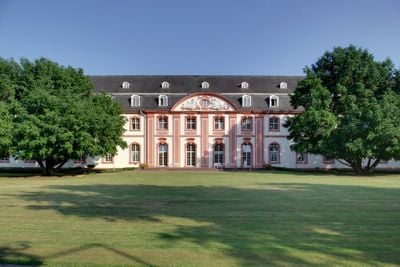
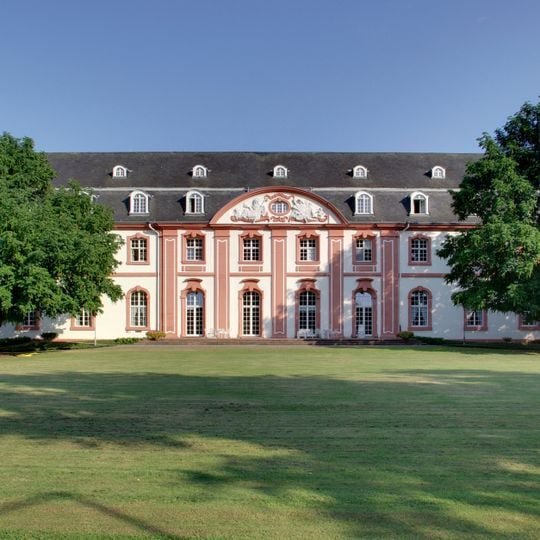
St. Irmine Abbey is a former Benedictine monastery at Irminenfreihof in Trier, not on the Moselle. Its church, built 1768–1771 to plans by Jean Antoine, is a single-nave hall church with a four-bay nave and slightly recessed choir; the southeast tower survives from the 11th-century Romanesque church. The white two-storey building with pink-red trim, arched glass doors and a curved pediment faces a lawn; remains of Roman harbour warehouses are visible in the complex.
The monastery was founded between 645 and 659 and initially followed the Columban Rule. In 966, Otto I placed it under the control of the Archbishop of Trier.
The abbey was first dedicated to St. Mary; the name St. Irmina only came into use around the end of the 10th century, when Irmina was canonised and made co-patron. Her late hagiography, written by Theofrid of Echternach 400 years after her death, made her the legendary founder, though she was in fact the second abbess after Modesta. The church, rebuilt 1962–64, keeps the name.
The west wing dates from the mid-18th century, while the church was built in the late 1700s. Visitors should note that the complex is partly visible from the Moselle riverbanks and can be reached on foot.
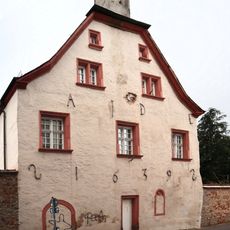
The abbey stands on the site of Roman harbour warehouses (horrea), which gave it the name "Oeren". Excavations in the east part uncovered foundations of densely packed dwellings and workshops from the 1st to 4th centuries, partly conserved. The Roman harbour halls are still recognisable in parts of the complex, divided by blind arcades.
The community of curious travelers
AroundUs brings together thousands of curated places, local tips, and hidden gems, enriched daily by 93,404 contributors worldwide.