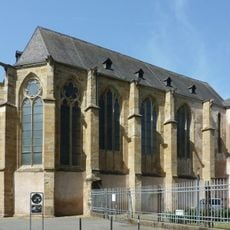
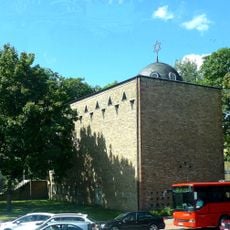
St. Antonius, Gothic parish church in Trier, Germany.
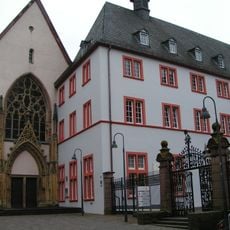
St. Antonius is a Gothic parish church in Trier with pointed arches, ribbed vaults, and tall windows set into its stone exterior. The building displays the vertical emphasis and technical precision typical of medieval German religious architecture.
St. Antonius was built between 1458 and 1514 as a successor to the chapel of St. Antonius, replacing the church of St. Maria zur Brücke outside the city walls, whose remote position had cost it importance. Originally late Gothic, it received Rococo elements later. In the Second World War it was badly damaged, including two windows made before 1900 by Alexander Linnemann of Frankfurt; the Trier architect Heinrich Otto Vogel rebuilt it and restored the largely destroyed vaulting.
The church is dedicated to Saint Anthony the Hermit, and its name lives on in Antoniusstraße, the street beside it near the Viehmarkt. The Rococo pulpit of 1762, possibly from Ferdinand Tietz's workshop, came here in 1812 from the Dominican monastery by the cathedral when that house was demolished; it carries figures of evangelists, Church Fathers and Dominicans.
St. Antonius stands on Antoniusstraße by the Viehmarkt in Trier's Mitte district, a short walk from the Hauptmarkt. The interior is entered from the street side; the tall main nave with its net vault and the lower, asymmetrical side aisle are the two spaces to compare. Look for the 1762 Rococo pulpit and the two sandstone epitaphs of 1607 and 1609 in the side aisle.
The two sandstone epitaphs in the side aisle, made in Hans Rupprecht Hoffmann's workshop in 1607 and 1609, commemorate mayor Cornelius Schott and the synodal judge Leonhard Eisenkrämer. The Rococo pulpit of 1762, possibly from Ferdinand Tietz's workshop, was moved here in 1812 from the Dominican monastery near the cathedral when that house was demolished.
The community of curious travelers
AroundUs brings together thousands of curated places, local tips, and hidden gems, enriched daily by 93,619 contributors worldwide.