Pfahlwege im Campemoor, Archaeological boardwalks in Neuenkirchen-Vörden, Germany
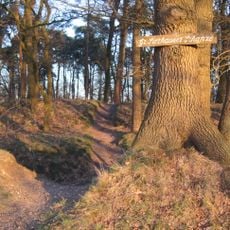
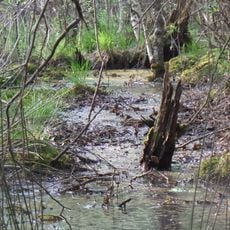
Pfahlwege im Campemoor are wooden pathways from the Stone Age that ran through a raised bog and were preserved under layers of peat and water. The paths consist of wooden planks laid side by side and several parallel structures that archaeologists have uncovered over the millennia.
Six prehistoric bog paths were found in the Campemoor and investigated from 1992 to 2004. The oldest, path 31 Pr, was built around 4550 BC in the Middle Neolithic, making it the oldest known bog path in the world. Its three-layer construction used birch trunks at the base, three parallel rows of pine trunks, and a walkway of pine logs up to 20 cm thick bearing stone-axe cut marks. Path 32 Pr, dated 2900–2879 BC, ran parallel 30 m away.
The paths are named Pr plus a number, after the bog researcher Hugo Prejawa. Excavations drew about 1,500 visitors on the 1996 Day of the Open Monument. Around 1 km southeast of the find sites, the men of Hunteburg found two bog bodies from the 3rd or 4th century in 1949.
The site is located in a bog area with wet and marshy conditions, especially during the wetter months. Visitors should wear appropriate footwear and familiarize themselves with the local information boards to fully understand the archaeological finds.
About one kilometre south-east of the find sites, two bog bodies from the 3rd or 4th century were found in 1949: the "Männer von Hunteburg". The paths themselves are named with the abbreviation Pr, honouring the bog researcher Hugo Prejawa. On the 1996 Day of the Open Monument, some 1500 visitors came to the excavation.
The community of curious travelers
AroundUs brings together thousands of curated places, local tips, and hidden gems, enriched daily by 94,407 contributors worldwide.