Residenzensemble Schwerin, Architectural ensemble in Schwerin, Germany.
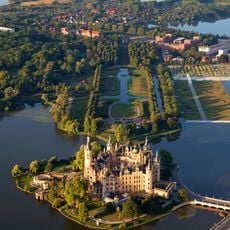
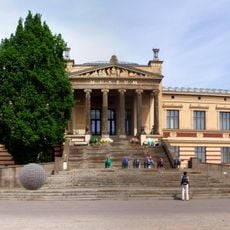
Residenzensemble Schwerin comprises the Schweriner Schloss on its island plus 37 buildings outside the Schlossinsel, among them the Kollegiengebäude, theatre, museum, cathedral, Schelfkirche, Paulskirche, barracks, Neustädtisches Palais, Marstall and court laundry. The palace, rebuilt 1843–1857 under Friedrich Franz II in Neo-Renaissance forms, holds the only surviving original throne apartment with throne room, ancestral gallery and castle gallery. The buildings grew from the early 18th century to a peak of construction in the 19th century.
The ensemble grew from early 18th-century buildings, with a peak of construction in the 19th century. The Schwerin Residence Ensemble was inscribed as a UNESCO World Heritage Site on 27 July 2024, following a nomination process that began in 2000 on the initiative of the Pro Schwerin association and was confirmed by city and state parliament decisions in 2001 and 2007.
The rooms and furnishings inside display how court life looked in the 1800s, with original pieces showing the wealth and daily habits of the ruling family. Walking through these spaces gives a sense of how the dukes and their household actually lived and conducted their affairs.
The 38 components lie both on the palace island and in the surrounding city, so plan a route between the two. The entire Schweriner Innensee forms the buffer zone, and the shore promenades run as far as Zippendorf. The garden landscape laid out after designs by Theodor Klett and Peter Joseph Lenné has changed little since the 19th century and serves as a recreation area.
The complex was deliberately designed with planned sight lines that frame different buildings and garden areas from specific vantage points around the city. These intentional visual connections create surprising perspectives that often go unnoticed by casual visitors.
The community of curious travelers
AroundUs brings together thousands of curated places, local tips, and hidden gems, enriched daily by 93,340 contributors worldwide.