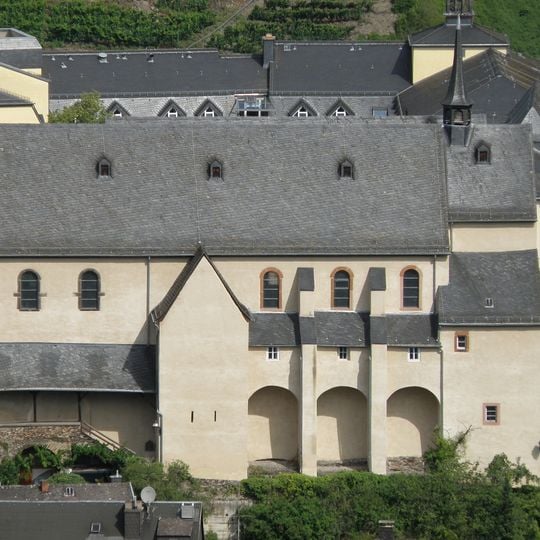
Kapuzinerkloster Cochem, Former Capuchin monastery in Cochem, Germany
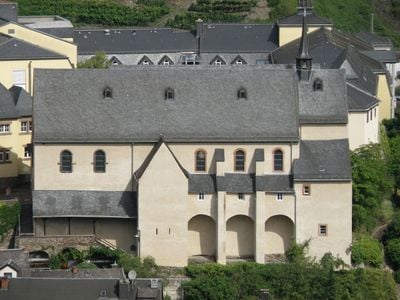
The Kapuzinerkloster Cochem is a former Capuchin monastery whose construction began in 1625 on the Kempeln site. Around a square cloister lie a plain two-storey east wing with refectory, kitchen and cells, plus a north wing with porter's lodge and guest rooms. The pale cream walls carry steep grey slate roofs; the front wing has three deep open arches and a slim octagonal turret with a pointed spire.
The site was given to the Capuchins in 1623 by Trier elector Lothar von Metternich, and the foundation stone was laid in 1625 by Abbot Johann Eberhard von Deusternau of Springiersbach. The round tower and an 8-metre rock of the former Burg Kemplon were removed to level the ground. The church was consecrated on 18 July 1635; after renovation the complex has served since 2008 as the Kulturzentrum Kapuzinerkloster.
The monastery now functions as a cultural venue hosting exhibitions, concerts, and theatrical performances that draw visitors throughout the year. These events bring new energy to the religious space while connecting people to local artistic life.
Since 2008 the complex has served as the Kulturzentrum Kapuzinerkloster, used for cultural, private and public purposes. The grounds sit in the town centre of Cochem, so they are reached on foot rather than by car. Check the centre's programme before travelling, as access depends on the event taking place.
The monastery ran a Latin school with a grammar-school character from 1627/28 for its own novices and gifted boys of Cochem. Martin von Cochem, born here in 1634 and later known for his popular religious writings, probably attended it; the physician Johann Lambert Joseph Comes, born in 1774, studied there until 1790.
The community of curious travelers
AroundUs brings together thousands of curated places, local tips, and hidden gems, enriched daily by 93,181 contributors worldwide.