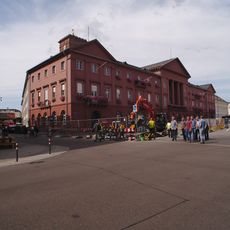
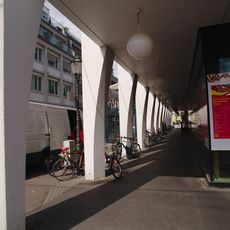
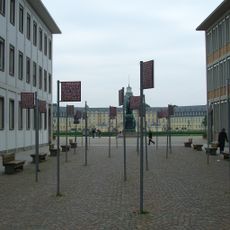
Bundesverfassungsgericht, Dienstsitz Schlossbezirk, Federal Constitutional Court in Schlossbezirk, Karlsruhe, Germany
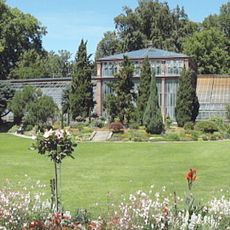
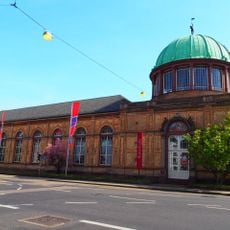
The Federal Constitutional Court is a courthouse in Karlsruhe comprising six modern pavilions with flat roofs spread across the Botanical Garden. The complex integrates functional design with its green surroundings and connects the buildings through open walkways.
The building opened in 1969 designed by Paul Baumgarten, succeeding the Prinz-Max-Palais which had housed the court since 1951. The new complex was built to provide more space and modern working conditions for the expanding institution.
The court's name is tied to its architect, Paul Baumgarten, whose glass-and-steel pavilions were modelled on the German pavilion at the 1958 Brussels World's Fair by Egon Eiermann and Sep Ruf. The building is a protected cultural monument of special significance, and around 260 people worked there in 2021.
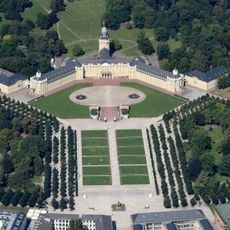
The Baumgarten-Bau is a working court building, not a museum, so the pavilions and connecting corridor are generally not open to the public. The green spaces around it, laid out following Walter Rossow's 1967 Bundesgartenschau path, connect to the adjoining Schlosspark and can be crossed on foot. The complex lies in the Schlossbezirk, a short walk from the Schlossplatz.
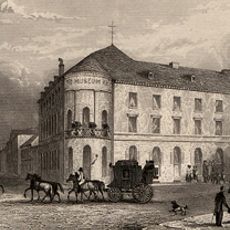
The site was previously occupied by the Grand Ducal Theatre, built 1851–1853 by Heinrich Hübsch, which burned out in a 1944 air raid. Paul Baumgarten first won a competition to rebuild the theatre, but after the 1964 decision for a new court building the ruins were demolished, to the displeasure of many residents.
The community of curious travelers
AroundUs brings together thousands of curated places, local tips, and hidden gems, enriched daily by 93,065 contributors worldwide.