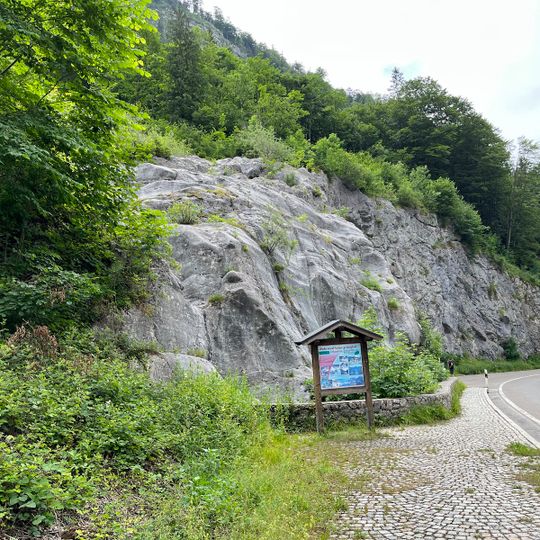
Gletschergarten Weißbach, Natural monument in Schneizlreuth, Germany.
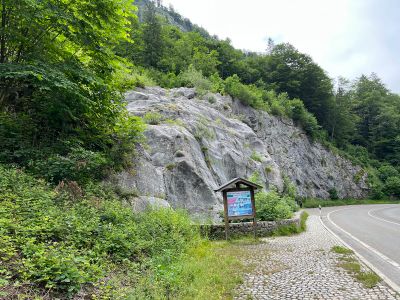
Gletschergarten Weißbach is a 2,500-square-metre geotope on the B 305 at 702 metres above sea level, laid bare in 1934–1936 during construction of the Deutsche Alpenstraße. Its surface is almost entirely covered by polished glacial rock, the dark grey Partnach limestone of the Ladinian shimmering bluish where the ice smoothed it.
The ice that carved these rocks came from the Rottraun glacier, a left branch of the Würm-period Saalach glacier fed by the Kitzbühel Alps and the Hohen Tauern. Around 12,000 years ago, as it retreated, meltwater buried the polished rock under mud and gravel. Road builders uncovered it between 1934 and 1936 during construction of the Deutsche Alpenstraße.
The name refers to the glacial features exposed here, not to a garden. The site lies directly beside the Deutsche Alpenstraße, which was built in 1934–1936 and cut open the rock. Visitors can feel the direction of ice flow: the surface is smooth in the direction the ice moved and rougher against it.
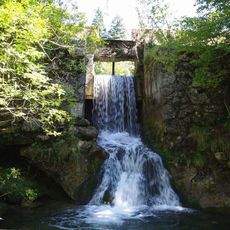
The geotope lies directly on the left side of the B 305 German Alpine Road towards Weißbach, about 600 m south-southeast of Zwing; parking is possible on both sides of the road. The 2,500 m² site at 702 m above sea level is reached on foot from the roadside. The Weißbach stream flows over a waterfall step just below the site.
The rock surface feels smooth in the direction the ice flowed and rougher against it, because the lee side of small humps was polished while the stoss side was torn. The dark grey Partnach limestone also appears bluish where it was polished. The ice reached roughly 1000 m here, about 300 m thick, according to Klaus Doben (1973).
The community of curious travelers
AroundUs brings together thousands of curated places, local tips, and hidden gems, enriched daily by 93,394 contributors worldwide.