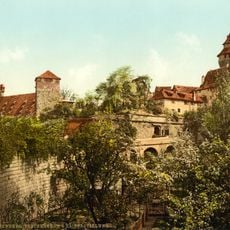
Sinwell Tower, Cylindrical stone tower at Imperial Castle, Nuremberg, Germany.
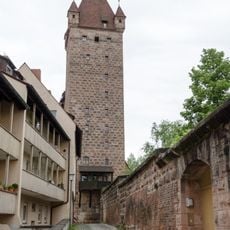
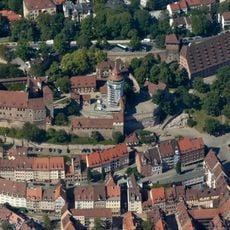
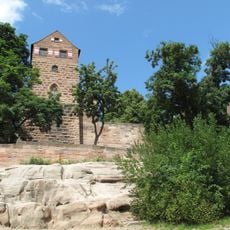
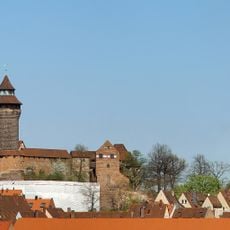
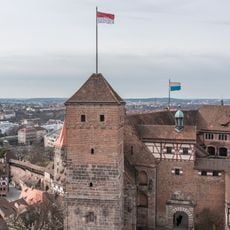
The Sinwell Tower is a cylindrical sandstone tower about 41 metres tall on a rock in the eastern part of Nuremberg's Imperial Castle. Its masonry is laid in rounded courses of right-angled sandstone blocks, and a Renaissance helm roof with a tent shape tops the added upper storey. A staircase of 113 steps leads up to the viewing level.
The tower was built in the second half of the 13th century on a rock in the eastern part of Nuremberg's Imperial Castle, using right-angled sandstone blocks laid in a circle. During renovation work in the 1560s, its pointed helm with four oriel windows was replaced by an additional storey and a tent roof with a Renaissance helm. It survived the World War II air raids, one of the few castle buildings to do so.
The tower's name comes from Middle High German "sinwell", meaning "mightily round", after its cylindrical form. It was built as a bergfried, serving mainly defensive and status purposes, and today its viewing platform over the city and surrounding land makes it a popular destination. Peregrine falcons nest in the tower, and their eyrie can be watched on a webcam.
The tower is climbed by 113 steps, and the top stands 389 metres above sea level, almost 100 metres above the Hauptmarkt. The exposed summit is reached on foot only, so allow time for the ascent. A webcam shows the peregrine falcon nest in the tower.
The tower's name derives from the Middle High German "sinwell", meaning "powerfully round", after its cylindrical form. Its walls are built of sandstone blocks cut square and laid in a circle. The tower survived the World War II air raids, one of the few buildings of the castle complex to do so.
The community of curious travelers
AroundUs brings together thousands of curated places, local tips, and hidden gems, enriched daily by 92,784 contributors worldwide.