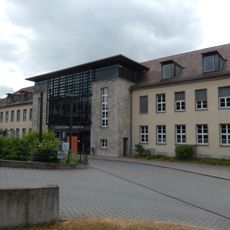
Schlachthof Weimar, Heritage monument and architectural structure in Weimar, Germany.
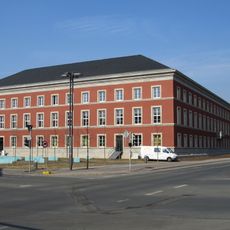
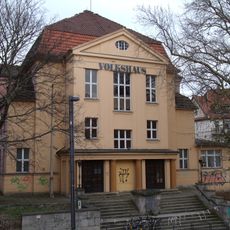
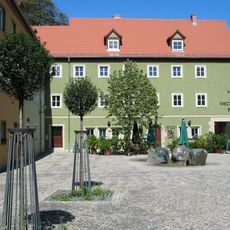
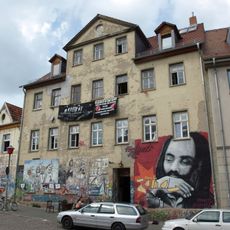
Schlachthof Weimar is a complex of buildings with early 20th-century industrial architecture, marked by red brick walls and large window openings. The sprawling site spans multiple plots and retains the typical layout of an urban industrial facility with workshop spaces, storage halls, and administrative buildings.
The slaughterhouse was built in the early 20th century as a municipal facility for meat processing and remained central to Weimar's industrial activity for decades. As industries shifted, the complex gradually fell into disuse before becoming the foundation for a new residential development.
The site is becoming the Kirschbergquartier, a development of about 500 dwellings on 66 hectares, one of the largest urban projects in central Germany. A street there is to be named Wolfgang-Borchert-Bogen after the writer Wolfgang Borchert. Bus line 3 still stops at the old Schlachthof.
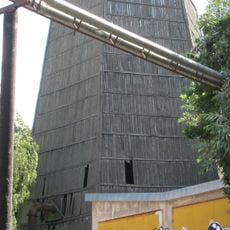
The site lies along Schlachthofstraße 4–6, between Bahnstraße and Am Kirschberg/Eduard-Rosenthal-Straße, and bus line 3 stops at the old Schlachthof. The grounds are being redeveloped as the Kirschbergquartier, a 66-hectare project with around 500 flats, so expect construction and possible cordons. The preserved cooling house is still in use.
The site is being redeveloped as the Kirschbergquartier, a 66-hectare project with around 500 flats, one of the largest urban development schemes in central Germany. A street there is to be named Wolfgang-Borchert-Bogen after the writer. Bus line 3 still stops at the old Schlachthof.
The community of curious travelers
AroundUs brings together thousands of curated places, local tips, and hidden gems, enriched daily by 94,018 contributors worldwide.